


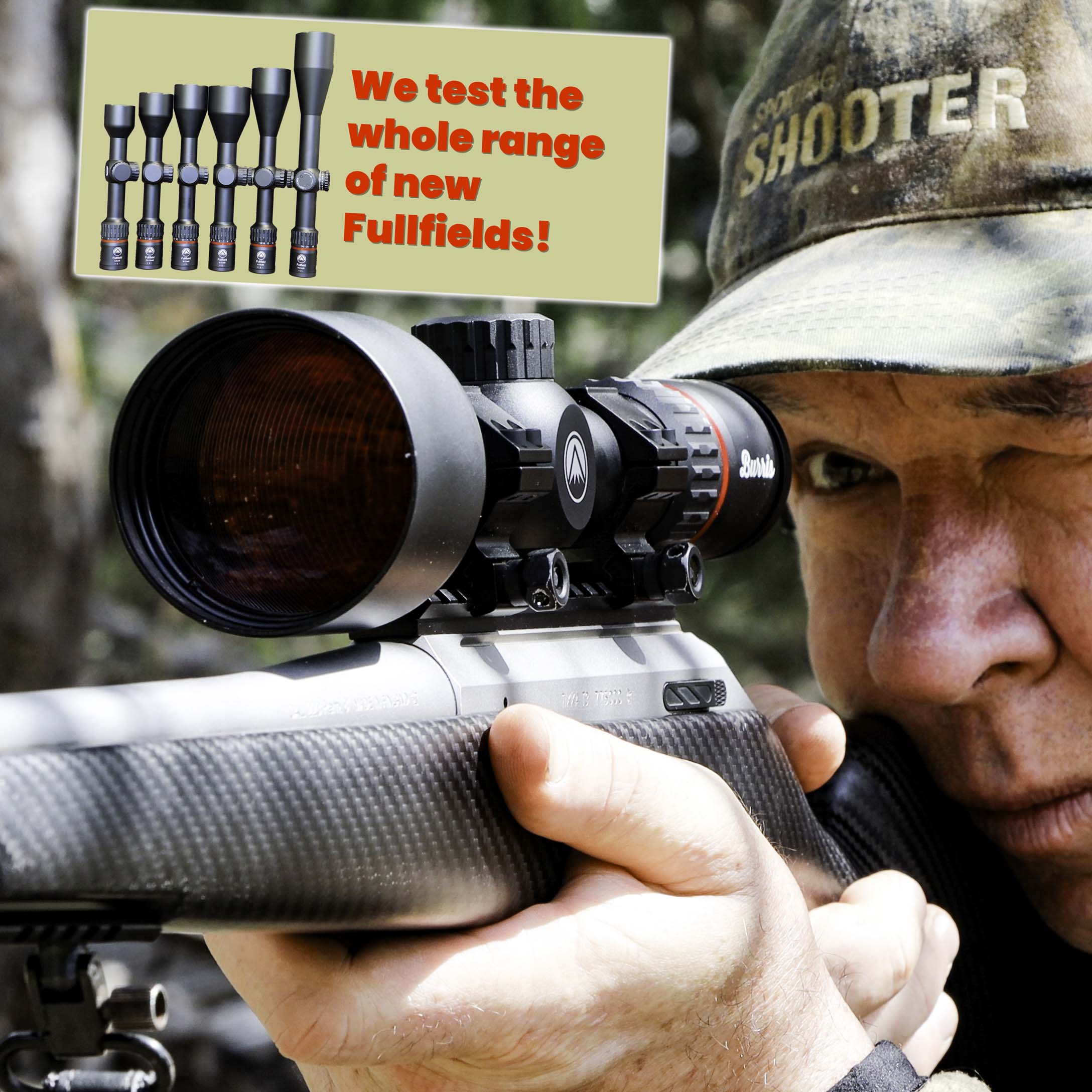



The six scopes here represent the full range of the new Burris Fullfield rifle scopes, from the tiny 2-8×35 up to the 6-24×50. It’s the first time I’ve had a full range of scopes together at the same time, which not only gives us a chance to look at their performance but also to consider how they relate to each other and the different uses you might put each one to.
Burris has been building Fullfield rifle scopes since 1975, and to celebrate the 50th anniversary they released these fifth-generation models.
Fullfield design has continued to evolve over half a century but there’s one thing that has not kept pace: the price, which has seemingly lagged behind, so much so that even the 6-24×50 model costs only $699.
So they’re cheap but, as we’ll see, far from nasty. And they come with Burris’s Forever warranty, which basically means a scope will be repaired or replaced if manufacturing faults show up at any time in the future.
I’ve often kept scopes for years as the rifles underneath them have come and gone, and that’s when lifetime warranties develop real meaning.
The combination of price and guaranteed quality has a lot to do with the fact that Fullfields are made in the Phillipines.
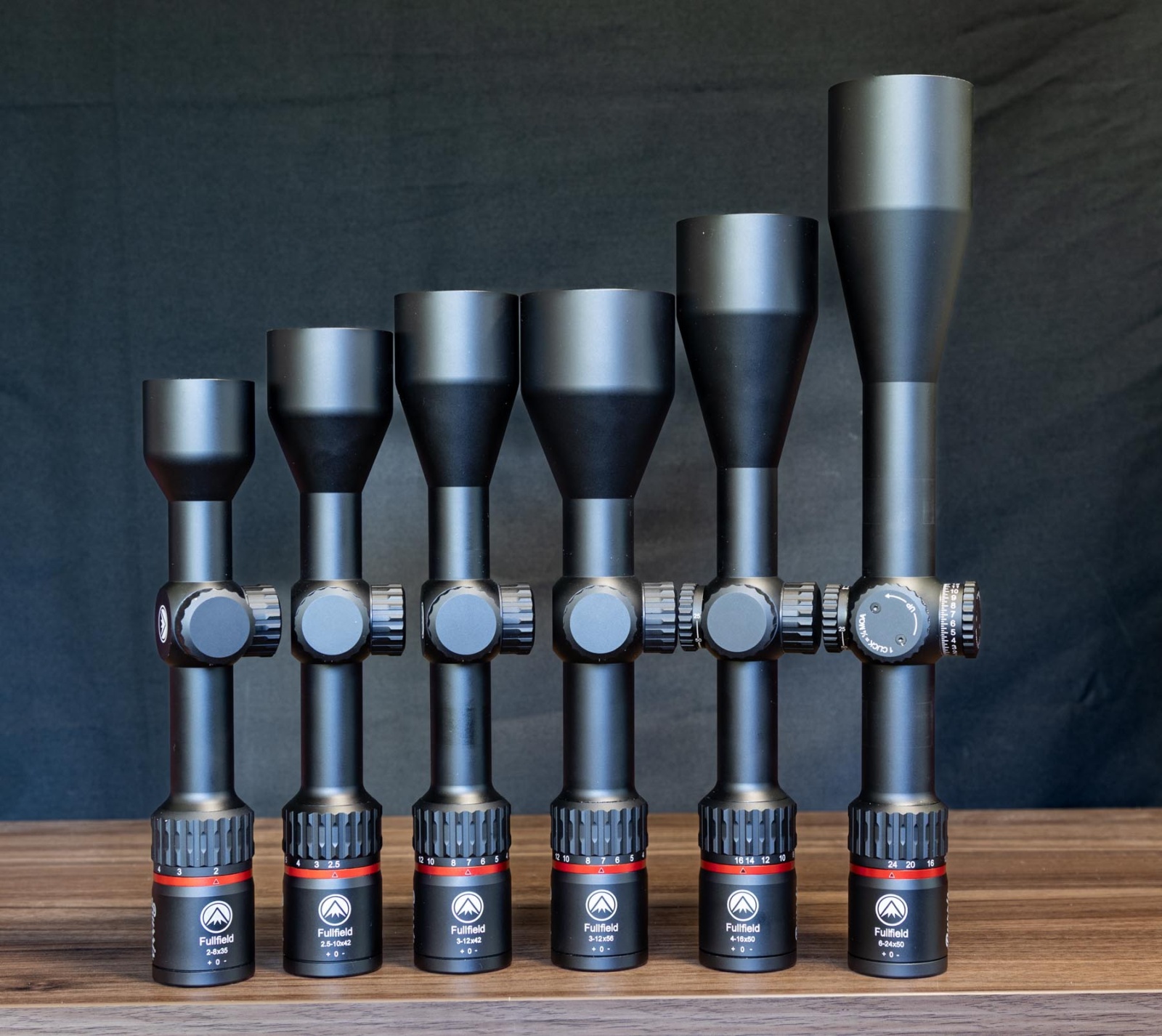
For this new Fullfield series, Burris has made them shorter, lighter and stronger, and definitely more striking in design with their stumpy objective housings. The Fullfields have been condensed.
Part of this is because of Burris’s improved erector system, which permits the scopes to be shorter overall without sacrificing magnification range.
Admittedly the erector ratio of 4x is relatively modest these days, but it certainly covers the crucial ground for hunting scopes.
Burris has created new turrets, too — what it calls the Burris Knob Synergy system, or BKS, and it is another aspect that brings the new line-up right up to date in rifle-scope technology.
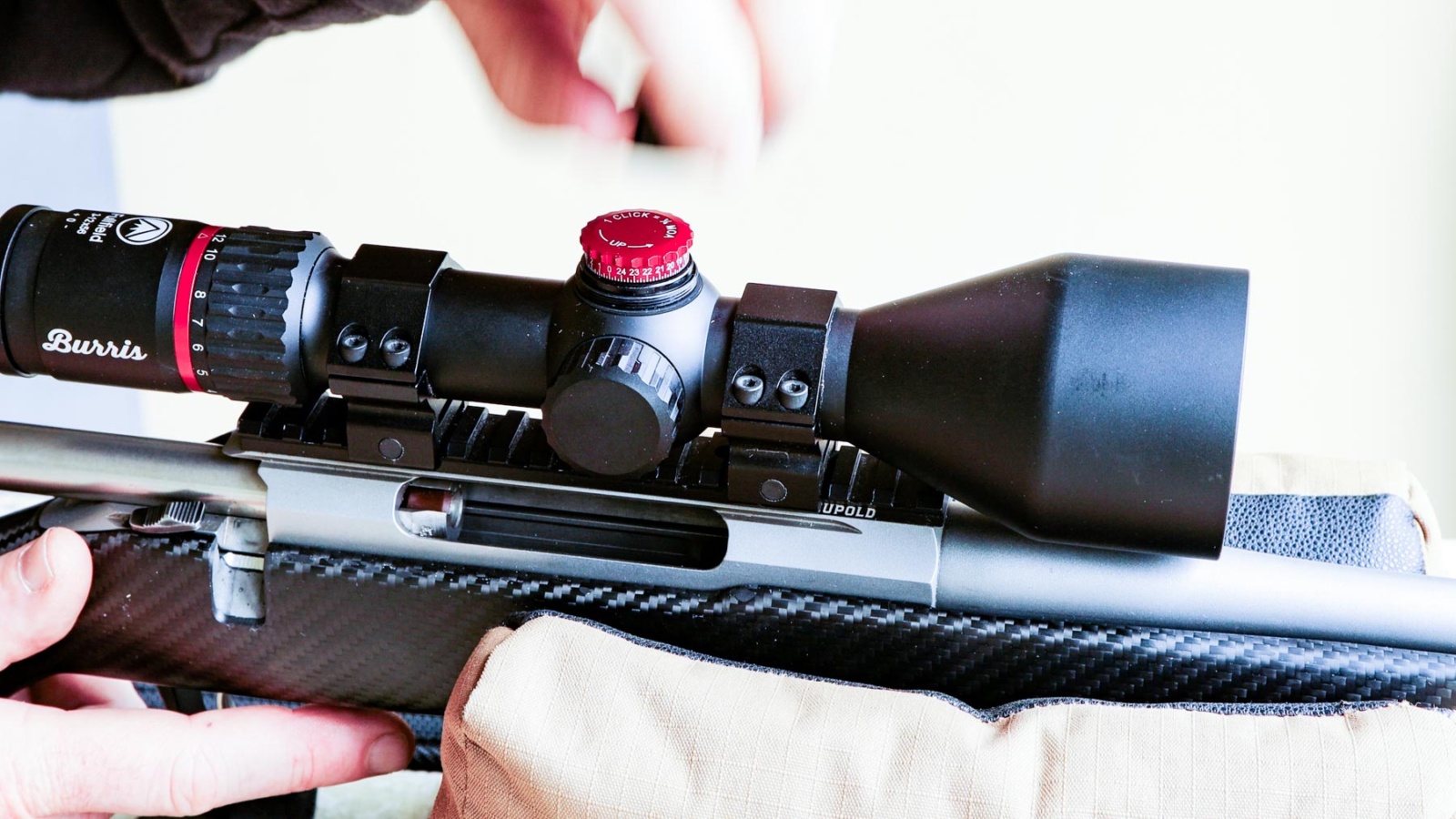
There are several different knob types — standard with caps, Advanced-Capped and Advanced-Exposed — and they are interchangeable, meaning you can upgrade yours if you want a change.
Better still, you can order a custom turret, engraved to suit the ballistic profile of your rifle and ammunition. It’ll come back marked for specific ranges, and you just have to dial in and take the shot.
The Fullfields also have new reticles, and you can opt for illuminated ones in some cases. The ones I sampled here were the simple plex with the thicker outer bars coming most of the way to middle (good for aiming small); a Ballistic Plex, which has three holdover graduations marked down the bottom post, a useful feature for shots beyond your rifle’s point blank range; and the E3 ballistic reticle, which has a range of MOA-based marks to help you estimate holdover and windage on the fly. The E3 is useful without being overly complex, and it’s easy to like.
LIGHT AND SMALL: 2-8×35 & 2.5-10×42
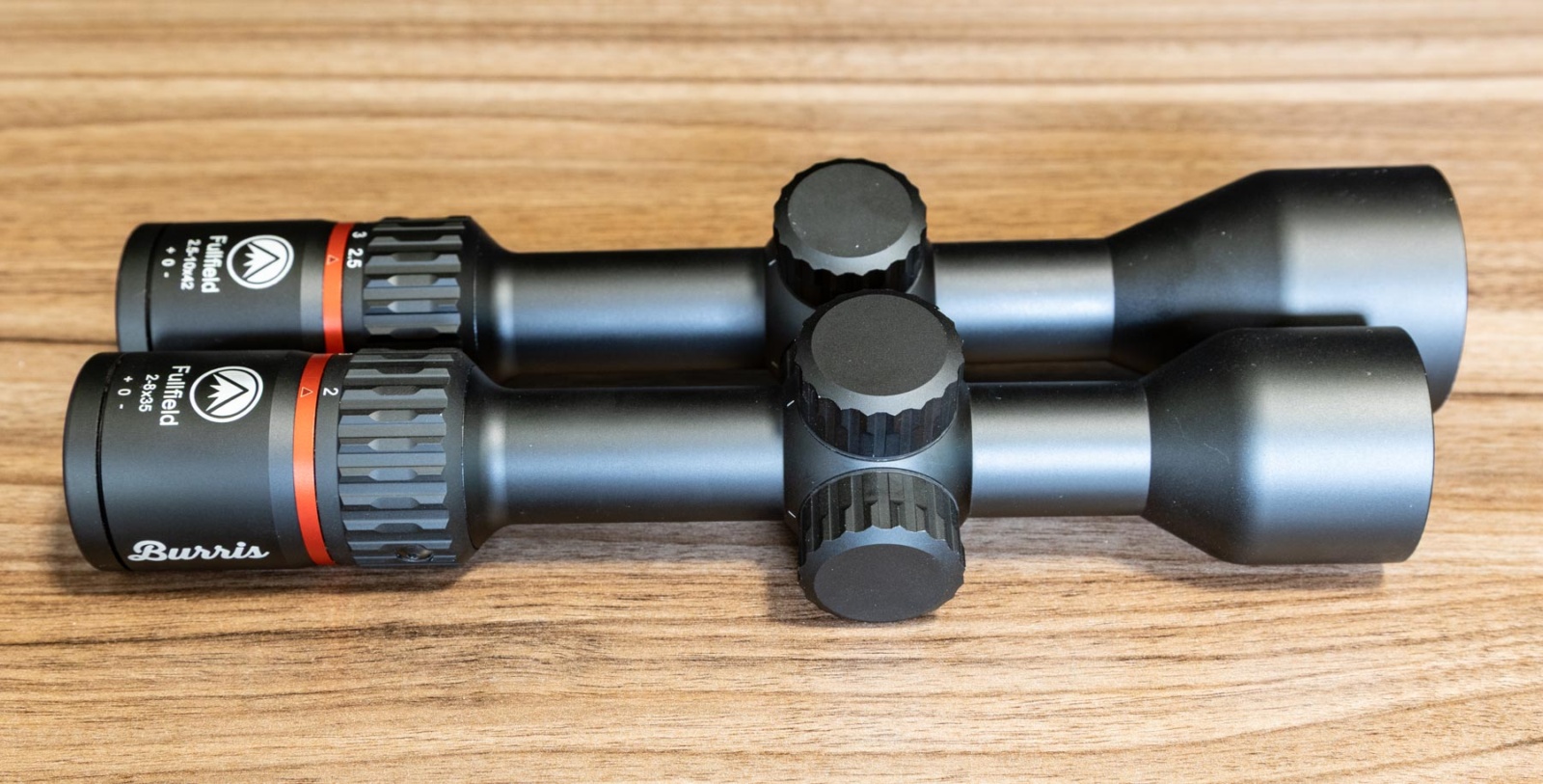
You can categorise the Fullfield scopes into pairs, and the first two are the little terriers of the range: a very compact 2-8×35 and the stepped-up 2.5-10×42. Both have 1” tubes and standard capped adjustment knobs.
The little 2-8×35 weighs only 380 grams and is just over 24cm long. It’s tiny! I gave it a run on my Scout rifle, which I’ve always favoured to close-range work, and its noticeably wider field of view was easily the best for fast target acquisition and close hunting. The view is about 18m wide at 100m — or more to the point, wide enough to quickly get onto a pig that’s only 25m away.
I’d also rate it for use on a .22 rimfire.
The only caveat I’d put on this one is that its short tube makes it less forgiving of where your rings are set, which could make it hard to get the eye relief just right.
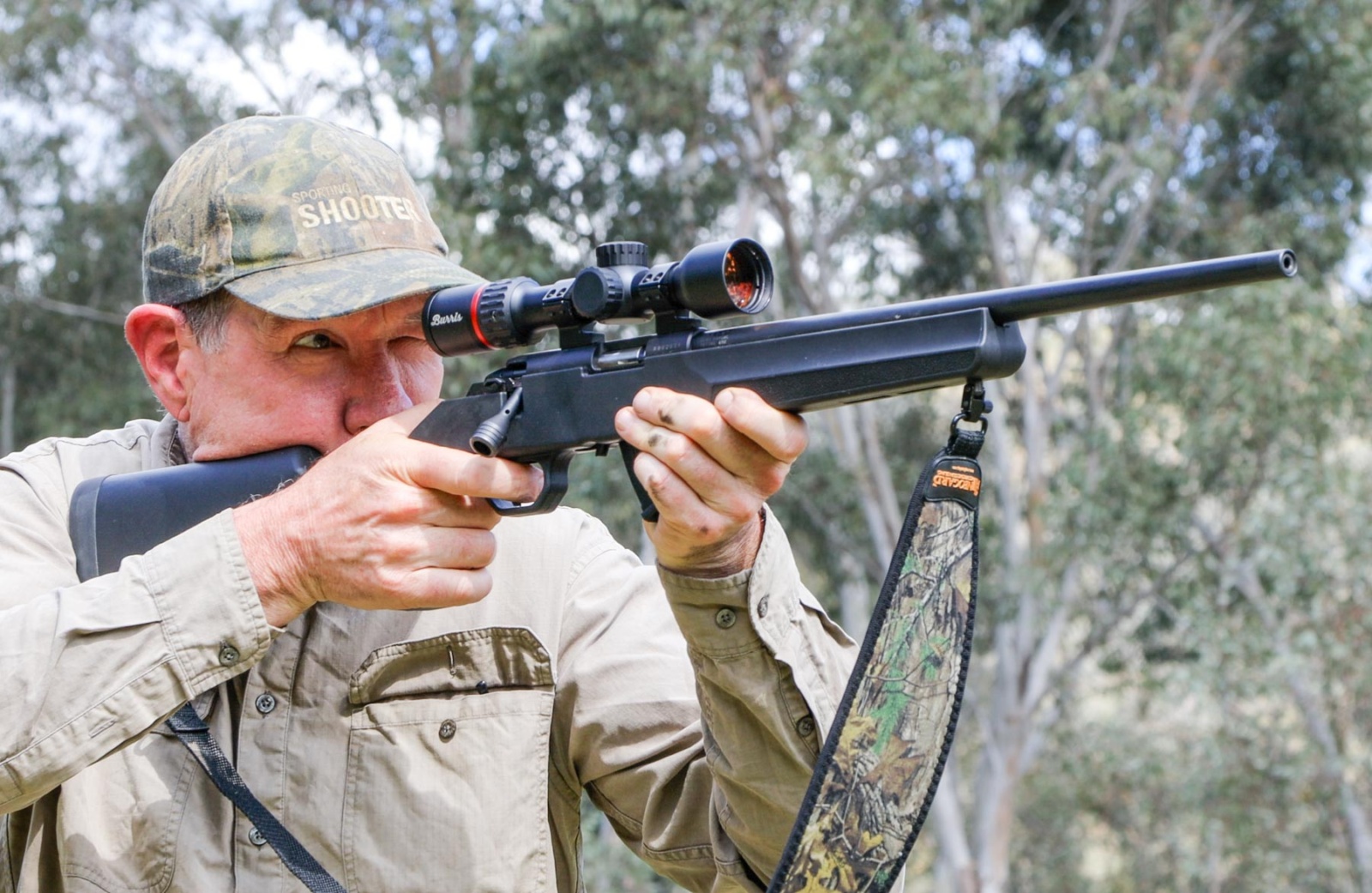
If you want a bit more magnification, the 2.5-10×42 gives it to you without adding very much size or weight at all — less than 60 grams and about 2cm. It’s a versatile thing, what you might call a modest all-rounder that will suit almost any hunting rifle and calibre.
Both the smaller scopes have decent low-light performance, with minimum exit pupils of about 4.5mm, meaning your eye will receive plenty of light until about halfway through twilight on maximum magnification, and you won’t have to dial back very far to get an exit pupil bigger than your eye can take advantage of.
These both have their parallax focus fixed at about 100 metres.
THE SWEET SPOT: THE 3-12x DUO
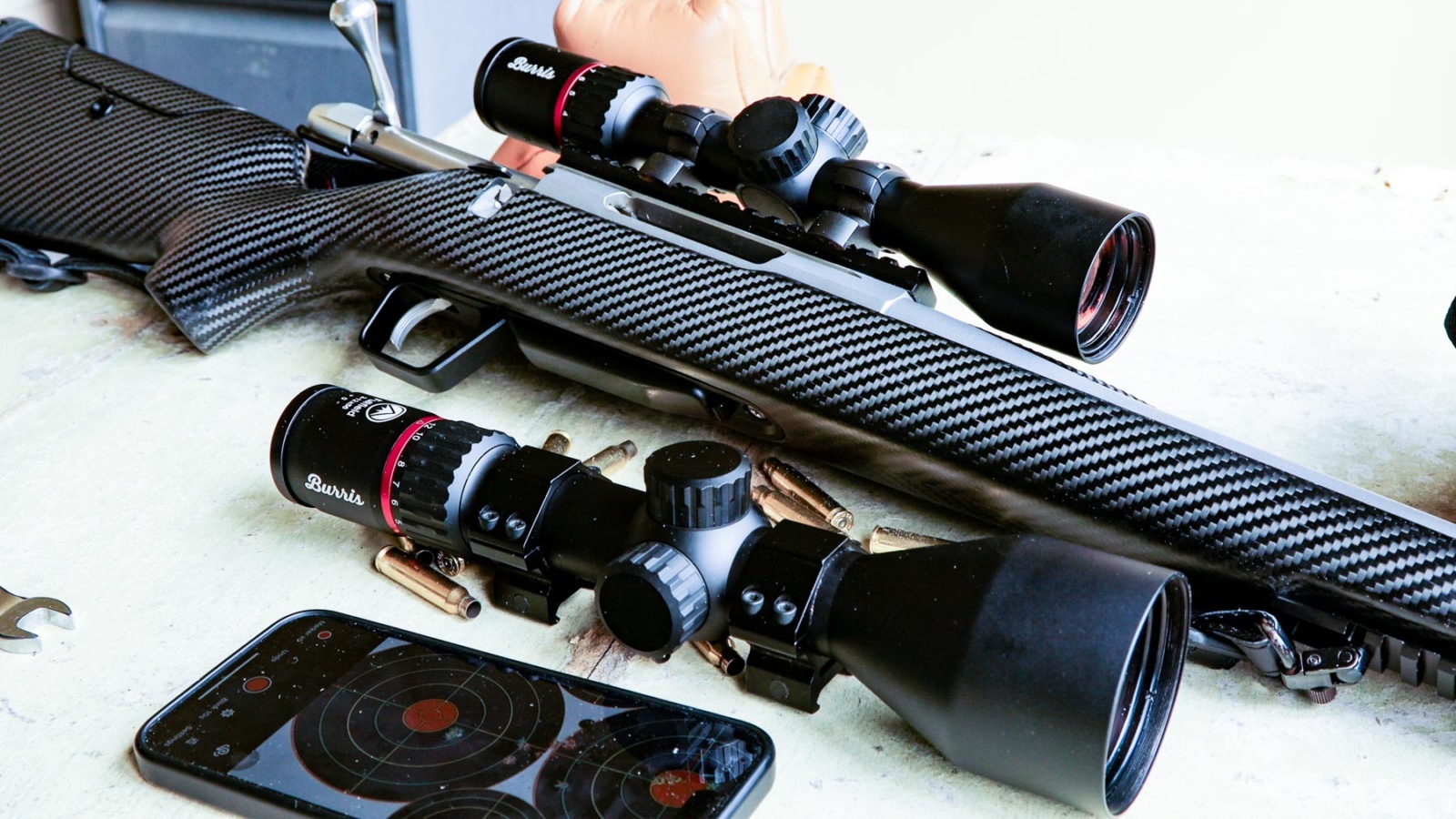
The next pair has a magnification range of 3-12x. I’ve come to think of 3-12x scopes as being an excellent choice for all-round hunting, at least in anything that has a four-fold erector ratio. It’s the sweet spot, with enough wide-angle view at the low end of the scale and plenty of magnification up at 12x.
True, varminters and long-range shooters benefit from greater magnification at times but any regular hunter who says they need more is having a lend of themselves.
The smaller 3-12x Burris has a 42mm objective like the 2.5-10x. The low-light performance of the two is very similar, except of course that as you wind the 3-12x past 10x the image won’t be quite as bright; anything less than that and there’s no advantage in either. However, the 3-12x gives you just a bit more range at the expense of close-up width, and your hunting terrain should dictate which suits you better. Even though the 3-12×42 is about 1.5cm longer than the 2.5-10, it’s a few grams lighter. But really, they’re virtually twins.
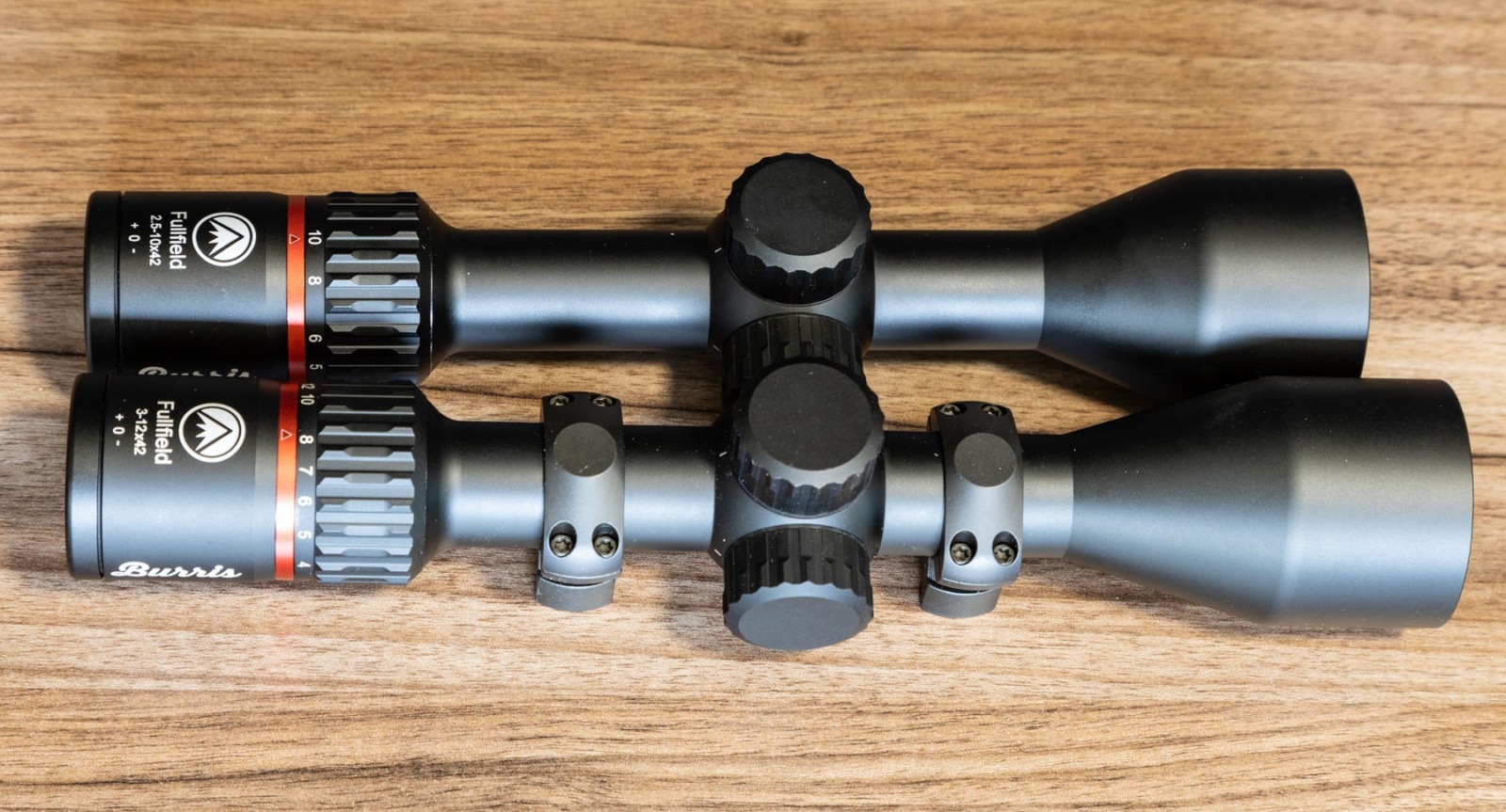
The 3-12×56 is the king of the Fullfields when the sun dips out of sight. Its lovely big objective lens results in the biggest exit pupil of all. This is the scope I used most out of the six Fullfields because it’s the ultimate all-rounder with the most versatile range of magnification and the greater ability to accurately aim in first and last light.
My preference with this scope would be to opt for an illuminated reticle, to ensure you can really maximise its advantages.
It is mere millimetres longer than its 42mm sibling but it weighs more than any other Fullfield. Still, to put that into perspective, we’re talking less than 550 grams, which makes it one of the lightest scopes in its class.
It makes the transition to a 30mm main tube, as opposed to the 1-inch tube on the 3-12×42.
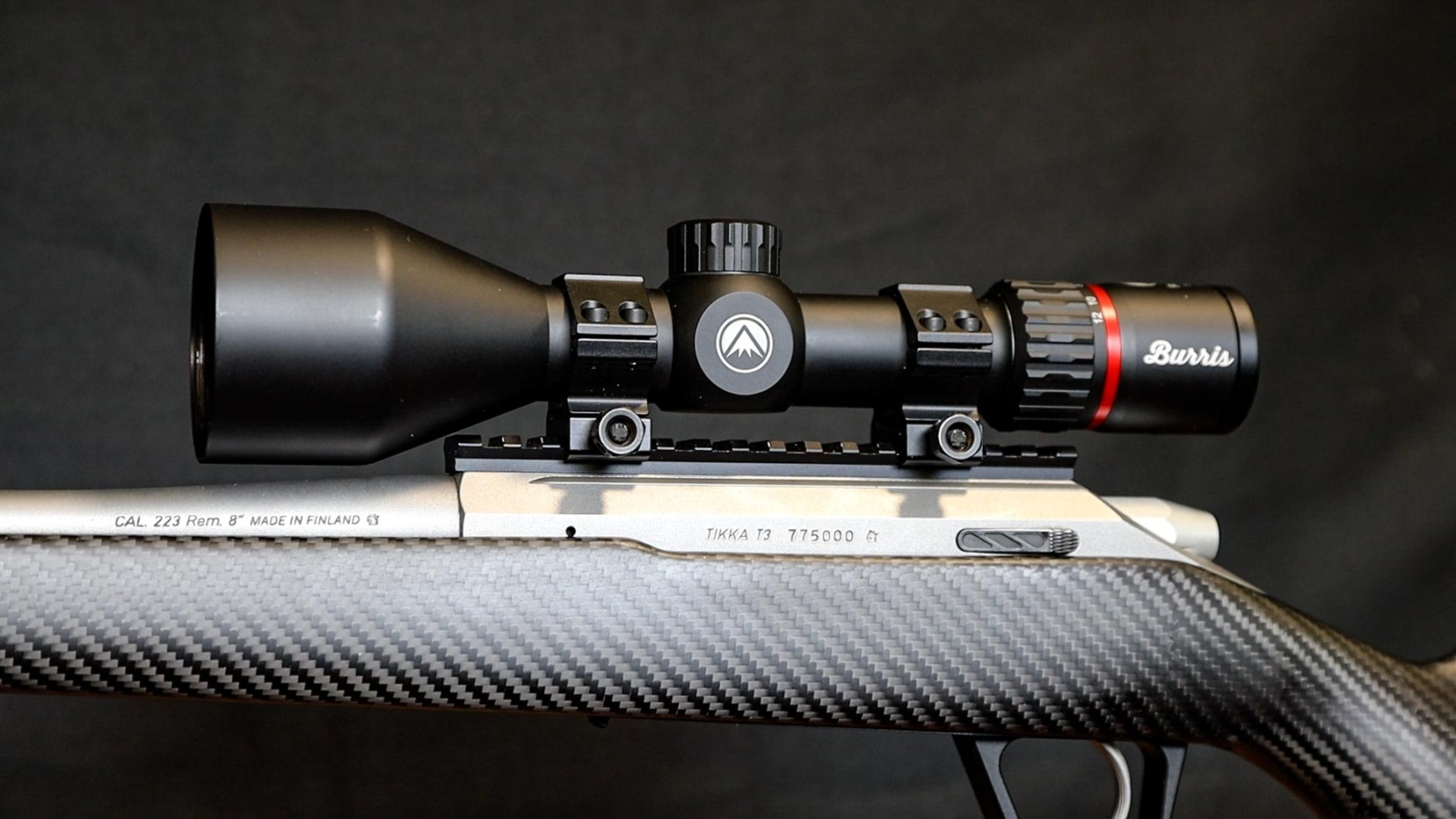
Let’s clear up one thing: the fatter tube doesn’t mean more light transmission. What it does is permit Burris to build in a larger reticle adjustment system with more reticle movement. This dictates the difference between the smaller scope’s 70 MOA of total adjustment compared with the larger one’s 93 MOA. That’s for both elevation and windage, and it’s the greatest variation in the Fullfield range by a fair margin. It’s an advantage a few people might appreciate but you’d probably opt for one of the Advanced turret knobs to make the most of it.
THE BIG GUNS: 4-16×50 & 6-24×50
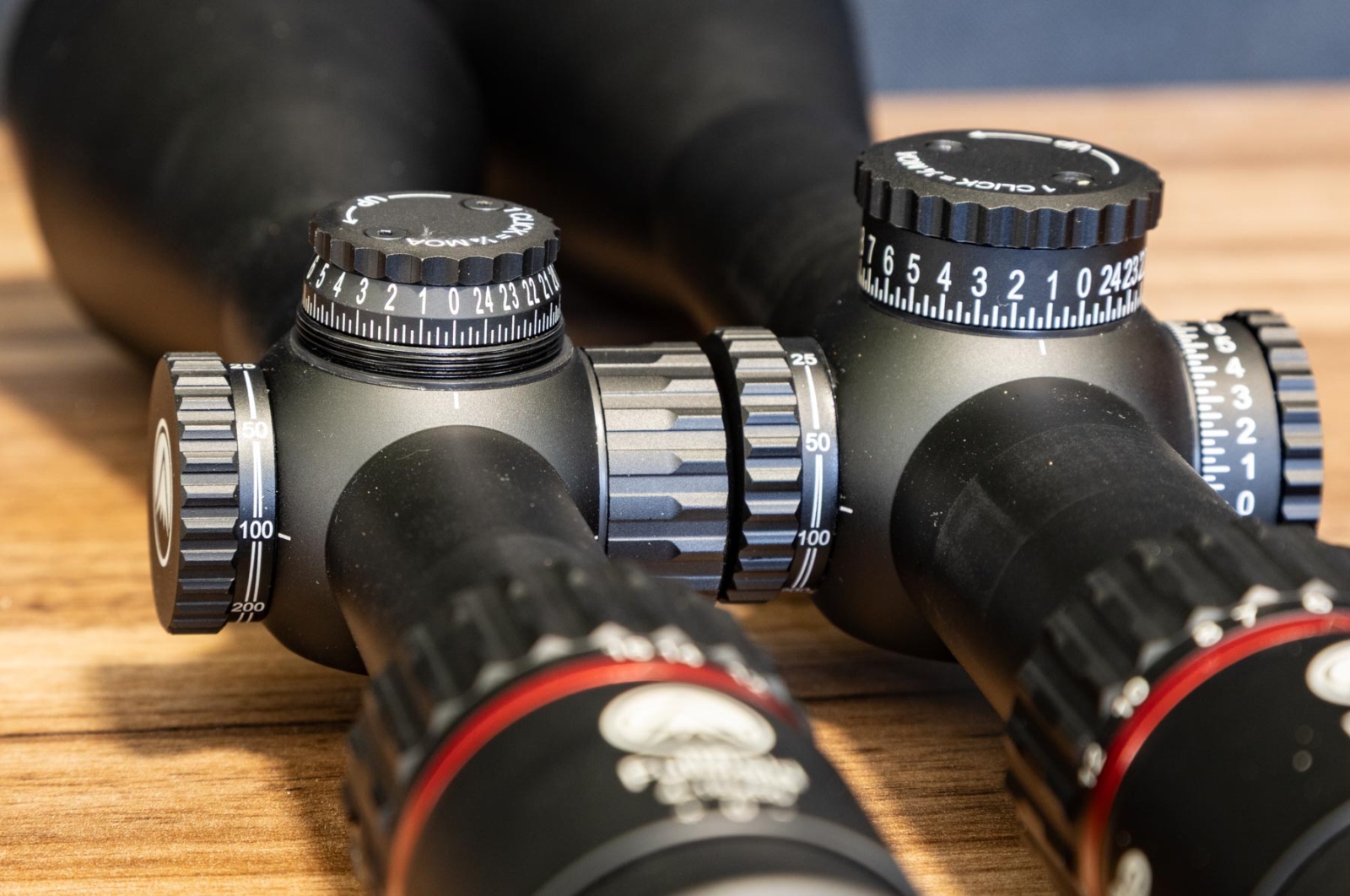
Which brings us to the biggest Fullfields, the 4-16×50 and 6-24×50. Both of them have Advanced knobs as well as adjustable parallax through a side-mounted dial, making it obvious Burris intends these for longer shots. Let’s start with the biggest.
There’s only one format for the 6-24×50 scope: it comes with the Advanced-Exposed knobs and with the E3 ballistic reticle. There was no doubt I’d fit this scope to my varmint rifle, to shoot small targets a long way away. The Burris is beaut in the long-range role.
The exposed turrets allow quick elevation and windage changes as required, and the click values are bang on the advertised ¼ MOA, as well as being utterly consistent in returning to zero. In a budget scope, that’s very impressive (and I’ll add here that while zeroing the other scopes I noticed the same thing, even if I didn’t test it to the degree I did in this one).
The clicks are so tactile they’re very easy to count, but the etched markings are also dead easy to read and line up. The zero stop is simple to set, too.
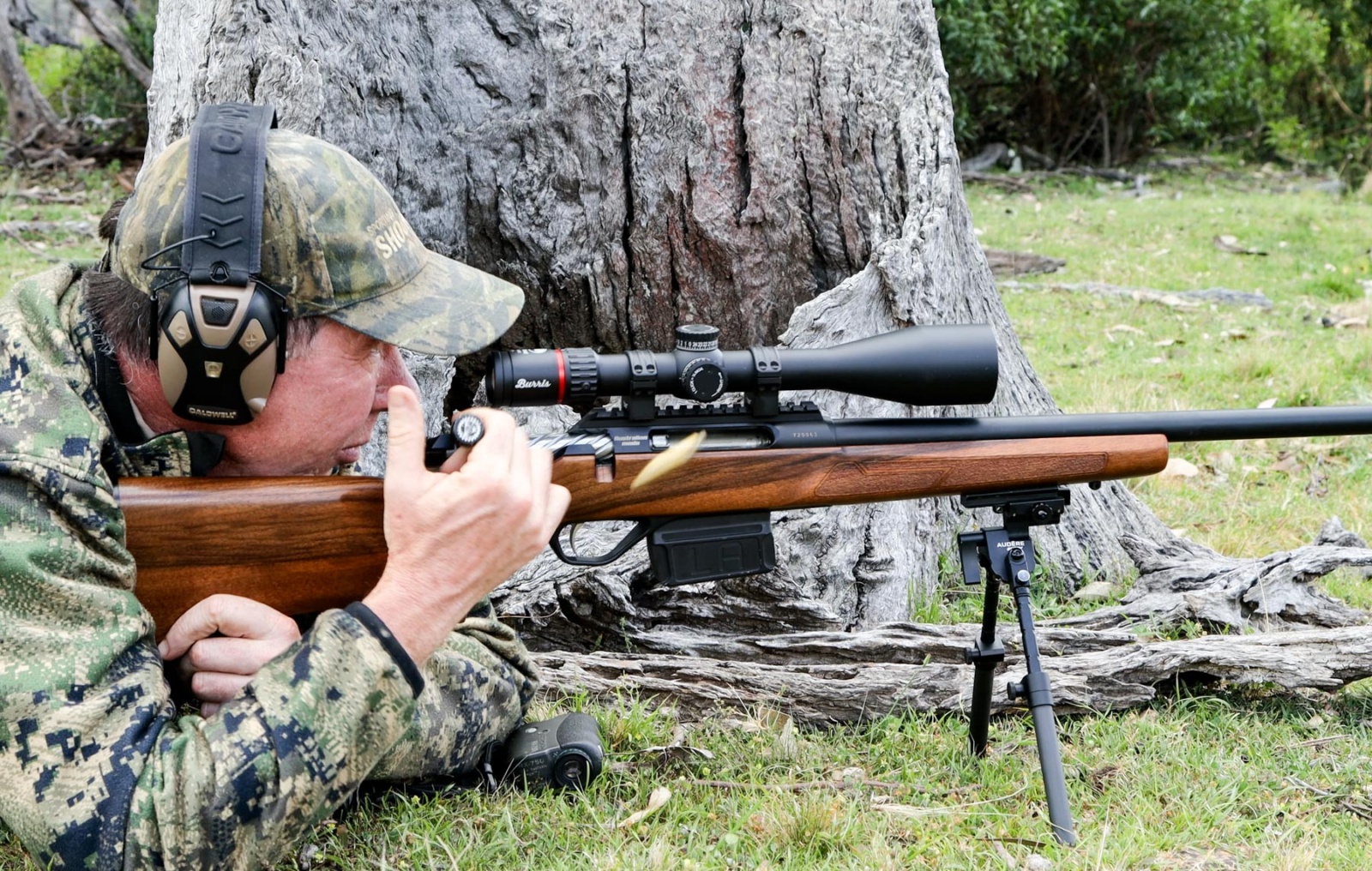
The parallax makes a real difference and finds a sharp focus at your target range without drama.
I can’t believe this scope costs only $700. Its precision and quality belie the price.
The 4-16×50 comes with a choice of several reticles, including an illuminated E3. Its 1” tube gives it slightly limited adjustment compared to the 6-24 with its 30mm tube, but few of us will need more than the 52 MOA it does have. That’s plenty for all but extreme long-range hunting.
The 4-16x has the Advanced-Capped knobs, which makes perfect sense for a walk-around hunting scope because you’ll never accidentally move them off zero. If you do want to settle in and dial up for a long-range shot, we’ll assume you have the few seconds necessary to remove the caps before making your corrections.
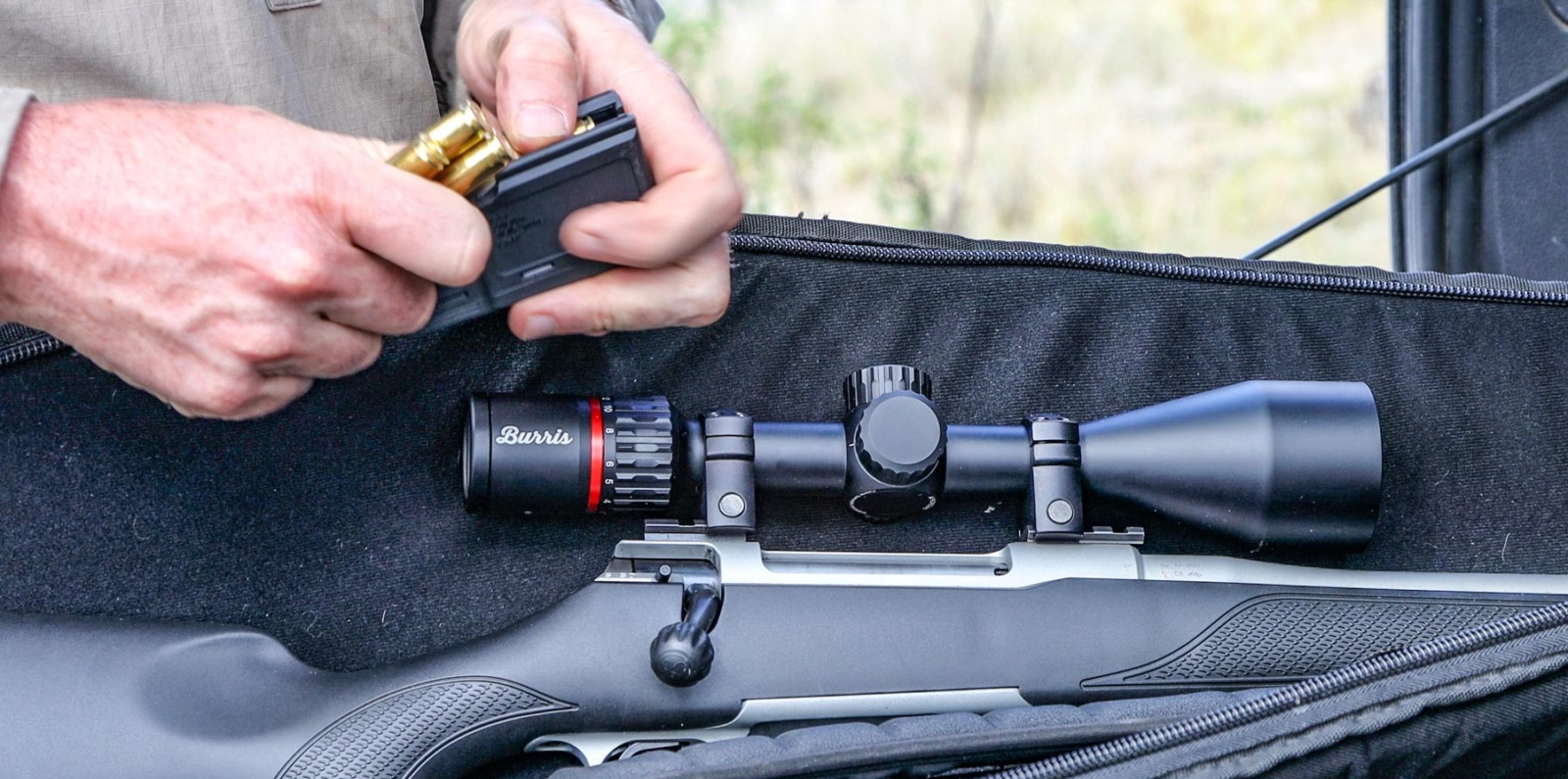
Under the caps, except for the shape, these knobs are the same easily adjusted, zero-stop design as the exposed version.
This is the scope I’d fit to a stalking rifle for longer shots in open country, chambered in a powerful and flat-shooting calibre like one of the modern magnums. And if you balk at the cost of that kind of ammo, just think how much of it you could afford if you bought this Burris instead of a much more expensive scope. This one will certainly do the job well.
FAMILY OPTICS
All the Fullfields are of course waterproof and fog proof, with an IPX7 exposure rating. The lenses are multicoated and I found the optics to be consistent across the whole range, in terms of both quality and performance.
But this is Burris’s entry-level range and so the optics aren’t as good as you’ll get in, say, the excellent Veracity range, where Burris really shows its hunting mettle. There’s some distortion as you get closer to the edge of the view, but you never notice when you’re fixed on the crosshairs where the view is sharp as a tack. Light transmission doesn’t appear to be as high as it is in more expensive scopes, with some greying of the colours in dull conditions.
It’s only in the more challenging condition you notice these things, though, and otherwise colour rendition, contrast and clarity are great. And I can’t be too critical when I consider the prices of these scopes.
The Fullfields are very well made, something reinforced by the consistency with which everything operated and performed across all six of the scopes I tested. You really wouldn’t know these were budget scopes. If you can’t spend a lot on your optics, or just don’t want to, have a good look at them.
SPECIFICATIONS
| Model: | 2-8×35 | 2.5-10×42 | 3-12×42 | 3-12×56 | 4-16×50 | 6-24×50 |
| Main tube: | 1″ | 1″ | 1″ | 30mm | 1″ | 30mm |
| Length: | 24.3cm | 26.5cm | 28cm | 28cm | 31cm | 36cm |
| Weight: | 380g | 417g | 417g | 555g | 495g | 540g |
| Field of view @ 100m: | 18.3-4.5m | 14.3-3.7m | 12.0-3.1m | 12.2-3.0m | 9.0-2.2m | 5.7-1.6m |
| Exit pupil: | 9.8-4.5mm | 10.1-4.6mm | 10.5-3.5mm | 9.7-5.0mm | 10.0-3.8mm | 8.5-2.9mm |
| Eye relief: | 76-86mm | 75-85mm | 75-88mm | 74-86mm | 76-85mm | 85-86mm |
| Elevation adjustment: | 79 MOA | 79 MOA | 70 MOA | 93 MOA | 52 MOA | 62 MOA |
| Windage adjustment: | 79 MOA | 79 MOA | 70 MOA | 93 MOA | 52 MOA | 48 MOA |
| Parallax: | Fixed | Fixed | Fixed | Fixed | 20m-infinity | 20m-infinity |
| RRP: | $369-$409 | $379-$449 | $449-$689 | $529-$689 | $679-$749 | $699 |
Burris scopes are distributed by Beretta Australia.


0 Comments