


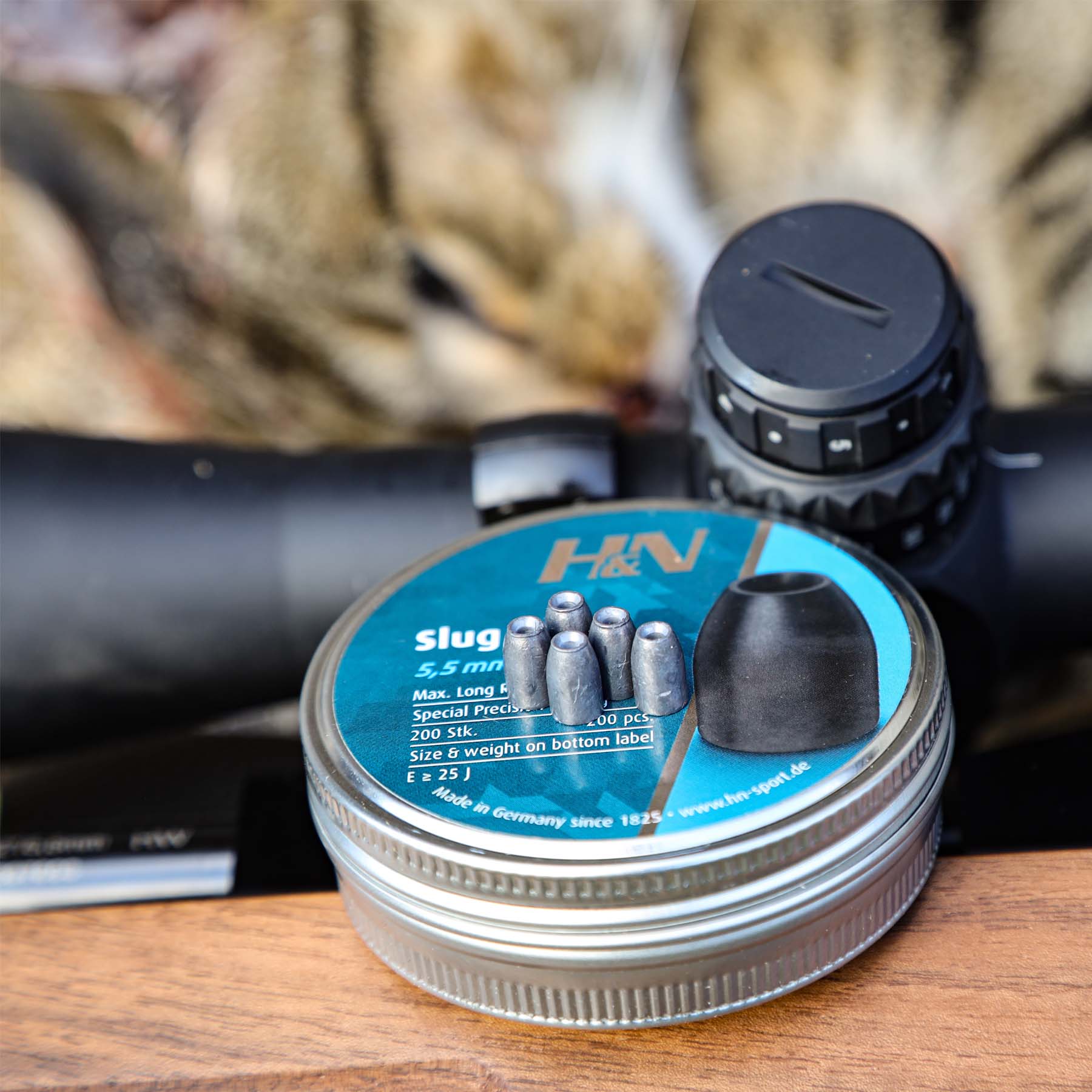


H&N’s hollow-point slugs take air-rifle hunting to a whole new level of lethality, not just for their design but for the accuracy you can achieve with them and the harm they do over longer ranges.
Experienced air gunners will know what I’m talking about but if this concept is new to you, start by forgetting everything you remember about your cheap old break-action.

There is a huge range of slugs in the H&N line-up, taking up where the lighter pellets leave off. From as light as 10 grains in .177, they step up to a whopping 54gn in .30 calibre. I tested .22-cal slugs in 21gn, 23gn, 25gn and 30gn.
Each batch of slugs weighed within .1gn of each other, based on a sample of 10 of each. H&N manufacturing consistency appears to be good. This was borne out by the excellent consistency in muzzle velocities and accuracy. Standard deviations were between 0.4 and 1.3m/s (1.1-4.6fps) across the board while the Weihrauch HW100 held its charge.
The hollow-point slugs are, naturally, designed for hunting and longer ranges of up to 200m, though the .22-cal ones I’ve tried are rated up to 100m. There are two types: the Slug HP and Slug HP II, the latter having a more advanced design with a hollow point that provides quicker expansion and energy transfer.
The effect of both types on pests is outstanding. During testing I used a 23-grain hollow-point slug to kill a feral cat all too easily, the slug’s pin-point accuracy and high impact dropping it on the spot at a range of 43m.

The best test came when I loaded up with 30gn HP slugs and tried to find a fox but instead saw a mob of five piglets feeding on a carcass. I snuck in to about 45m and shot two of them dead before the rest got spooked by their wildly thrashing siblings and bolted. The kill shots were both into the base of the ears, with instant effect. From the same distance I put five slugs into the body of one and then went to 25m to repeat the exercise with the other.
Some shots passed through at both ranges, indicating how much momentum these little lead meanies are carrying. The slugs I recovered showed exactly the same deformation you would expect of big-game hunting bullets in their context under equivalent circumstances, as you can see in the accompanying photo of three of the slugs.
They had smashed bones including in the front legs, and the pigs’ skulls were cracked. The damage to vital organs indicated that any hit in the chest would inevitably be fatal.
I didn’t get a good measure of whether the HP II slugs (which I had in 25gn) worked better, though.

H&N makes its .22-cal slugs in both .217” and .218” diameters for each projectile weight so you can select whichever works best in your rifle’s barrel. Working out which is best is a matter of trial and error in any particular rifle.
Accuracy from each weight and diameter was very good, all forming ragged one-hole groups of 10 rounds at 25m. The best group was 5mm, the largest 7.5mm.
More than that is the fact that H&N’s slugs are good for longer ranges, with ballistic coefficients of .091 to .106 in the ones I tested. I consistently hit minute-of-rabbit on a target 100m away. The vast majority of shots were equivalents of a kill, with very few landing outside the kill zone.
You do need a nearly windless day for it, of course.
The Weihrauch achieved muzzle velocities of 255m/s (888fps) with the 21gn slug, 248m/s (862fps) with 23gn, 236m/s (822fps) with the 25gn and 215m/s (748fps) with the 30gn. Those speeds gave a point blank range on a fox sized animal of about 50m.
You need at least 25J in your air rifle for these heavy slugs, and 40-60J is even better.
H&N’s hollow-point slugs are good quality projectiles that have the killing effect they’re designed for, and their accuracy gives you every chance to use it.
H&N projectiles are distributed in Australia by Alcock & Pierce.


0 Comments