


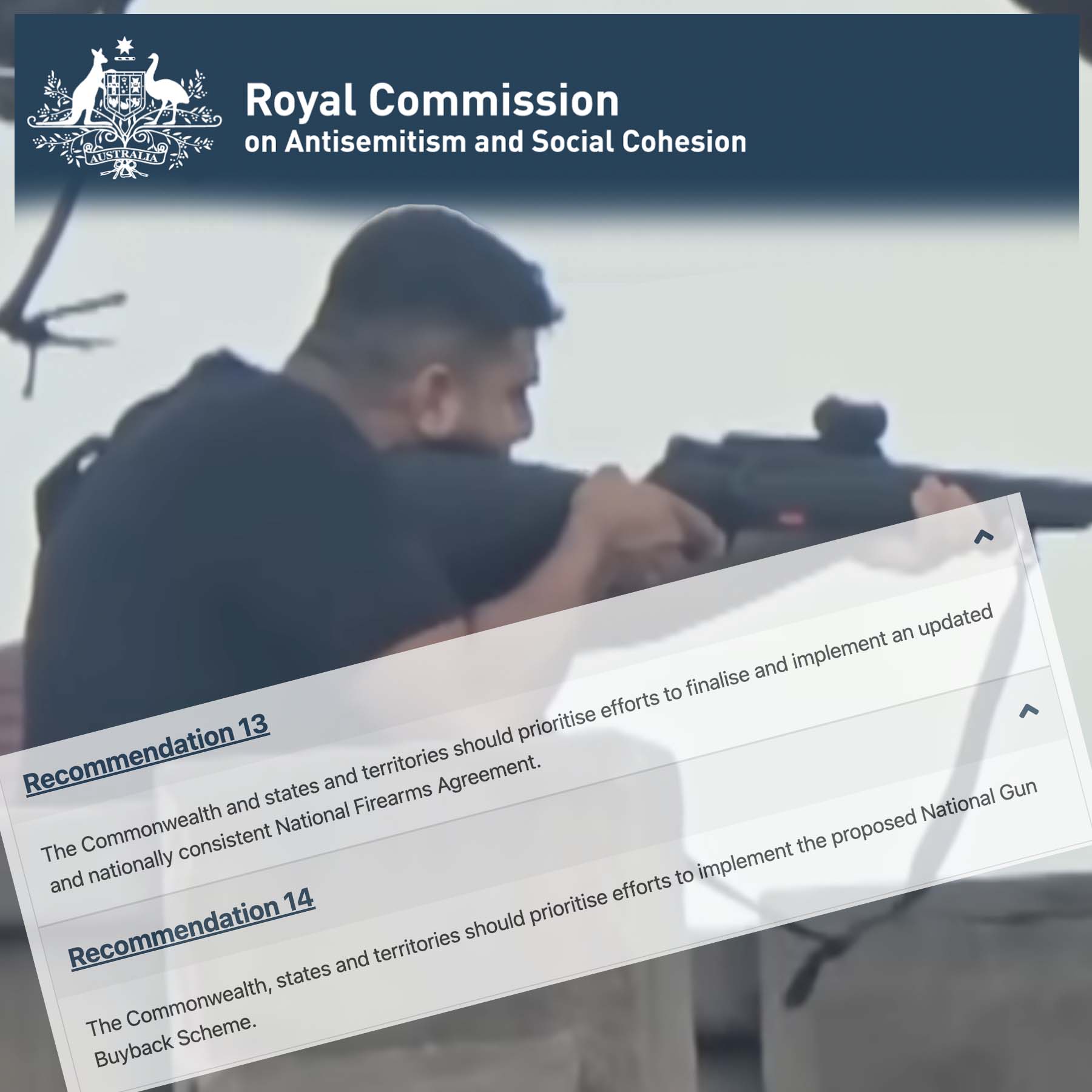



The Royal Commission Interim Report into Antisemitism and Social Cohesion has recommended changes to Australia’s National Firearms Agreement framework, despite reporting that police and intelligence agencies were not hindered by pre-existing laws prior to the Bondi terrorist attack on 14 December last year.
“No material or advice from any agency identified any gap in the existing legal and regulatory frameworks that impeded the ability for law enforcement, border control, immigration and security agencies to prevent, or respond to, an attack of the kind that occurred at Bondi,” the report states.
NSW rammed through new gun laws in the middle of the night on Christmas Eve, having pointedly refused to engage with anyone in the shooting community about the laws or how they would affect licensed gun owners and the wider firearms industry.
The Commonwealth Government implemented its own contentious changes to firearm import laws earlier this year.
Following the attacks, a Royal Commission headed by The Hon Virginia Bell AC SC was tasked with investigating matters including the circumstances surrounding the Bondi terrorist attack, anti-Semitism in Australia generally, and “any other recommendations arising out of the inquiry for strengthening social cohesion in Australia and countering the spread of ideologically and religiously motivated extremism in Australia.”
The Royal Commission’s interim report, published on 30 April, contains nine public and five confidential recommendations, two of which are directly related to firearms legislation.
Recommendation 13 states: “The Commonwealth and states and territories should prioritise efforts to finalise and implement an updated and nationally consistent National Firearms Agreement.”
Recommendation 14 states: “The Commonwealth, states and territories should prioritise efforts to implement the proposed National Gun Buyback Scheme.”
The report’s call for changes to the National Firearms Agreement foreshadows greater difficulties for licensed firearm owners.
“There may be concerns that these reforms will increase the regulatory burden on legitimate firearms owners and users, including those who require the use of firearms for their livelihood, such as primary producers,” it says.
“However, the use of licensed firearms in the attack at Bondi, as with many previous attacks and mass-casualty shootings, highlights the risks inherent in the availability of firearms.”
This is despite the report also acknowledging relevant existing laws and regulations, particularly relating to intelligence-sharing, were sufficient and did not impede the ability for law enforcement, border control, immigration and security agencies to prevent, or respond to, the Bondi terror attack or a similar incident.
“No Commonwealth or state intelligence or law enforcement agency has suggested that it was prevented from taking prohibitive actions before or on 14 December 2025 by the then-current legislative and authorising framework,” the report says.
“In these respects, no issue requiring urgent or immediate action has been identified.”
The interim report does not appear to address the contradiction between this observation and the recommendations for changes to the NFA, including implementing a firearms buyback.
The fact that no “urgent or immediate action” is required reinforces accusations that the NSW and federal governments reacted emotionally to introduce knee-jerk legislation that both said was an emergency.
The full Royal Commission Report into Antisemitism and Social Cohesion is due by 14 December.


0 Comments