


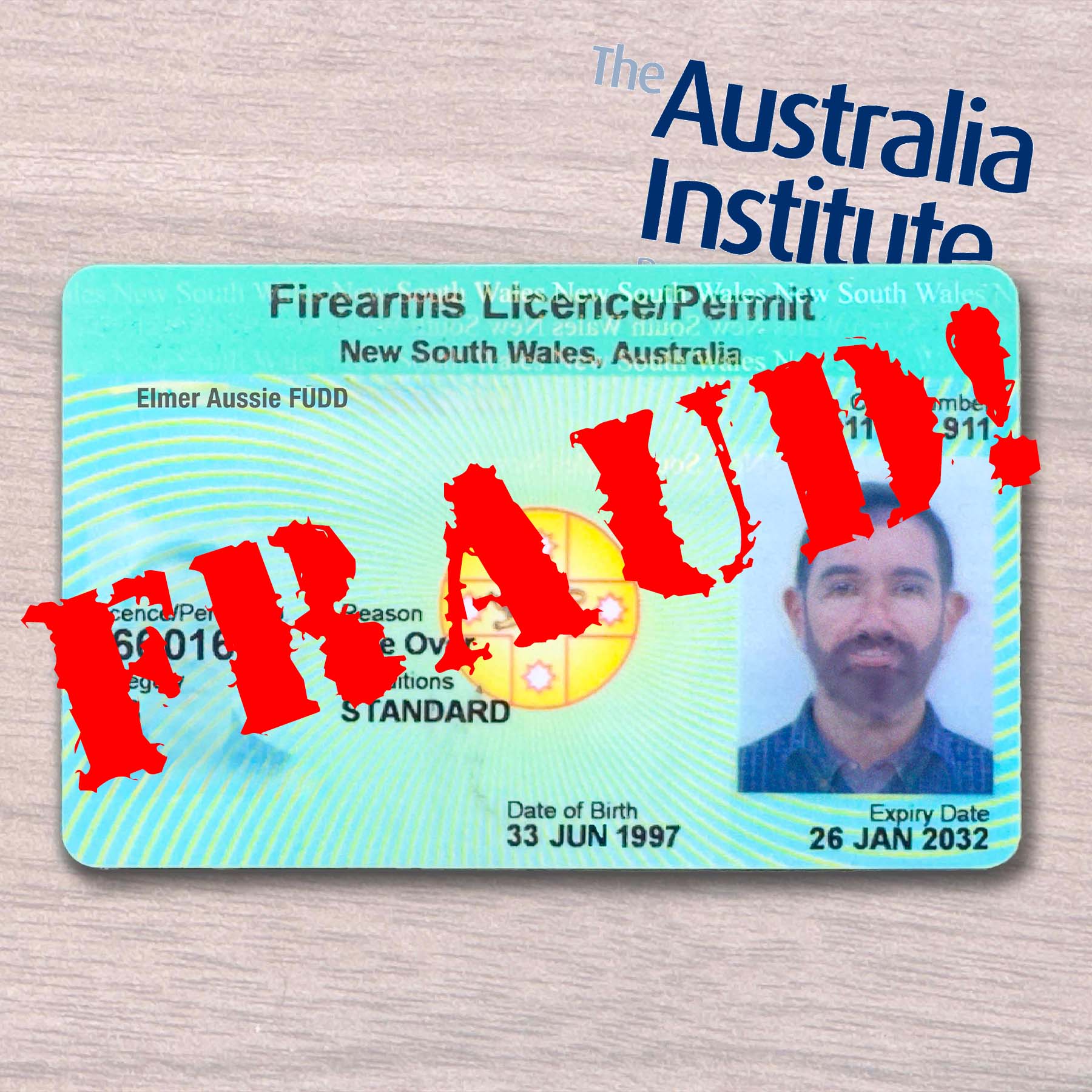


The Australia Institute report claiming more than 200,000 people in NSW hold firearms licences under fraudulent circumstances is not supported by its own evidence, according to independent researcher Daniel Gregg, who says the paper’s authors compared incompatible data sets.
The data were used in the report The hole in Australia’s gun laws, which concluded that about six out of seven licensed shooters in NSW did not legitimately participate in shooting sports or recreational hunting — “a striking claim,” in Mr Gregg’s words.
“Striking claims require robust evidence,” he said. “The evidence presented here does not meet that standard.
“The paper compares administrative licence counts (robust, purpose-built data) against a general population recreation survey, AusPlay, that was neither designed nor validated to measure firearms licence compliance.
“The resulting gap is treated as proof of systemic deception, when in fact it is an expected artefact of comparing two fundamentally different data instruments measuring two different things.”
The suggestion that about 86% of shooters’ licences are illegitimate has been dismissed by the shooting community, but one of the report’s authors, Rod Campbell, backed the figures.
He did directly not address questions about the suggested incompatibility of the data sets, but did say, “Our numbers are sound, coming from official sources: NSW Police for licence figures and the Australian Sports Commission Ausplay survey for participation.
“This suggests that many people have either illegitimately claimed to be hunters or sports shooters in order to acquire weapons, or they are not active shooters and do not have a genuine need for a gun.
“I understand your surprise with these numbers, but if you find it hard to believe the NSW Police data and the ASC data, you should direct your questions to them!”
Mr Gregg believes the Australia Institute has asked some genuine and useful questions about compliance and regulation but has not answered them.
He is critical of the authors’ attempt to propose legislative changes as a result of their claims.
“The paper moves from a flawed dataset straight to legislative proposals.”
Further, he points to the fact that the correct data to measure shooters’ compliance already exists but says the study’s authors did not ask for it.
The data that would provide the information is the NSW Police figures on shooters fulfilling mandatory attendance requirements at clubs. However, that data is not published, something Mr Gregg thinks should happen.
The Australia Institute report took a swipe at shooting clubs, claiming they “face few transparency requirements or public regulation … while avoiding public scrutiny,” a claim Mr Gregg takes issue with.
“The paper does not acknowledge that shooting clubs in Australia are already among the most compliance-burdened recreational organisations in the country — operating under strict range safety protocols, submitting participation records to police, and ensuring their members hold current police-issued licences,” he says.
“No equivalent recreational organisation carries anything close to that compliance load.”
There is merit in aspects of the paper but that in no way makes up for its deeply flawed basis.
“The Australia Institute claims that a gap of 200,000+ between NSW firearms licence counts and a recreation survey proves mass licence fraud. It does not,” he says.
“The comparison uses incompatible data sources, ignores why licensed owners would not disclose their activities to a government survey, and overlooks three decades of Australian Institute of Criminology data showing the licensed community is not the source of firearm violence.
“The paper identifies some real issues … but its headline conclusion is not supported by the evidence it presents.”
Mr Campbell dismissed the accusation.
“Based on the best available data the conclusion is clear – there are too many gun licences on issue in Australia and too many guns in the community.
“Active shooters should direct their concern towards the 200,000 people that are using hunting and shooting as cover to obtain guns that put the whole community at risk,” he said.
“[Sporting Shooter] could help their readers more by investigating why the number of inactive or illegitimate gun licensees is so high and spending less time complaining about the Australia Institute.”
Daniel Gregg is an independent researcher who has direct experience designing and implementing behavioural screening and probationary frameworks for firearms clubs and in forensic settings, drawing on SPJ-based threat assessment instruments including TRAP-18 and VERA-2R. His commentary was submitted in a personal capacity.


0 Comments