


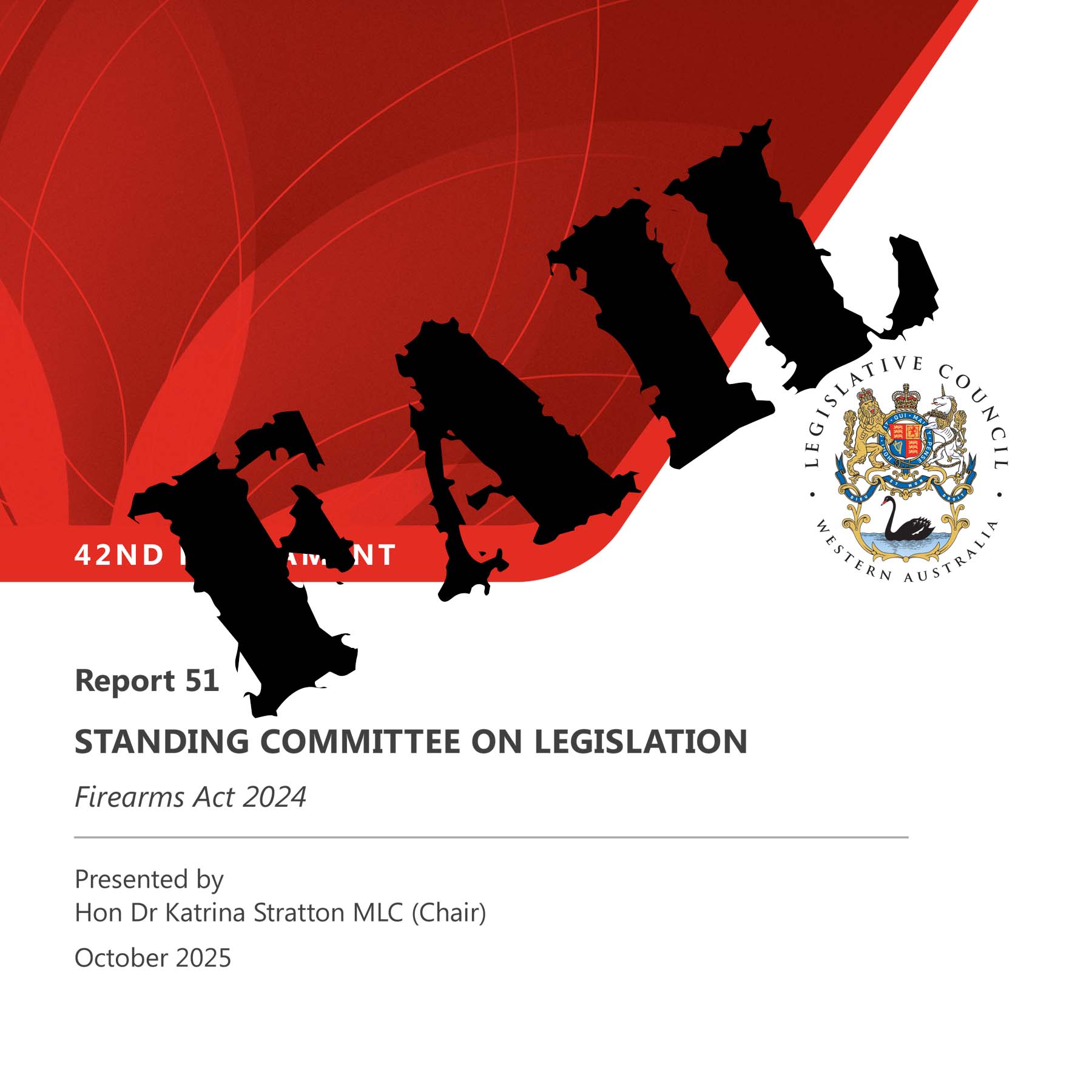

The West Australian Government’s Firearms Act 2024 was presented as a long-overdue modernisation of outdated legislation, however, what the government ultimately delivered was an Act and accompanying Regulations that was rushed through Parliament, with an absence of consultation, accountability, and evidence-based policymaking.
Since the new laws came into effect, there has been well publicised issues with the implementation, effectiveness, and operation of the Act, leaving the West Australian Labor Government red-faced and under pressure from the shooting community, media, and the Parliament itself.
On 28 May 2025, a motion to refer the Firearms Act to the Standing Committee on Legislation was successful, with the Committee subsequently handing down its report on 16 October 2025.
The inquiry received 2670 submissions, and noted that only 45 were from invited stakeholders, while the remaining 2625 were unsolicited and “almost universally critical of the legislation”. Hearings were also conducted, though shooting community stakeholders were given limited time to present their concerns.
Despite the extent of submissions and testimony that outlined the major problems and deficiencies within the new laws, and a clear dissenting view by a minority of the Committee, the report produced 47 findings and 11 recommendations, none of which proposed any legislative reform.
The Committee also dismissed all objections and concerns raised as being ‘unfounded’, choosing instead to endorse the government’s narrative and legislative process, highlighting that this entire inquiry was more about political symbolism, rather than sound governance.
COMMITTEE MANDATE BOUND BY MAJORITY CONVENIENCE
The Committee’s published Terms of Reference were broad. They required the Committee to examine the operation, effectiveness and implementation of the new Act and Regulations; and to report on problems that have emerged from implementation and operation; to recommend amendments to improve their workability; and to inquire into any other relevant matter. These are not narrow instructions; they were designed to ensure full accountability for one of the most significant law reforms in recent Western Australian history.
Despite this, the Committee chose to reduce its own mandate and dismiss evidence that challenged the government’s narrative. From the outset, the report acknowledges that “a great many submitters complained that they were not consulted on the Bill, or were not ‘heard’, or that consultation was inadequate or misleading”, before concluding bewilderingly, “that consultation process is outside of the terms of reference for this inquiry, and the Committee makes no comment on it”.
The same pattern recurs throughout the report. A further example is the concerns raised by medical professionals about the design and ethics of mandatory health assessments; these were ruled out of scope on the grounds that “what occurred before the Act and Regulations came into force is not within the terms of reference for this Committee inquiry”.
Likewise, systemic implementation failures, including the malfunctioning WA Firearms Portal and the breakdown in public communication, were ignored, even though they fall squarely within the requirement to examine the Act’s operation, effectiveness, implementation, and “any other relevant matter”.
By narrowing its scope, the Committee built a firewall, insulating the very agencies responsible for the failures it was meant to examine. What should have been an inquiry into accountability became an exercise in cover, protecting ministers and WA Police from scrutiny, while dismissing the legitimate grievances of those most affected. The outcome is a report that meets the letter of its mandate, but utterly fails its intention, an opportunity to restore public confidence and deliver evidence-based reform.
DISMISSAL OF SHOOTING COMMUNITY AND INDUSTRY EVIDENCE
Perhaps the clearest indicator of bias appears in the report’s Executive Summary. When summarising the submissions received, the Committee states, “Much of what the Committee was told was based upon supposition and speculation. Many of the concerns raised were unfounded”. That sweeping statement means that legitimate data driven evidence, presented by the Shooting Industry Foundation of Australia (SIFA), the Sporting Shooters’ Association of Australia, licensed firearm dealers and primary producer advocacy groups, was also dismissed and considered as nothing more than conjecture.
SIFA’s evidence directly contradicted the government’s position. We demonstrated that numerical firearm limits have no evidentiary basis, and that national crime data shows no correlation between legally owned firearm numbers and violent crime. We also highlighted that poorly designed regulation, implemented without industry consultation, undermines both efficiency and compliance.
By contrast, the report is abounding with untested and unchallenged statements and assurances from gun control advocates, WA Police, former ministers or other government stakeholders, that the committee has accepted as fact, without further question or scrutiny.
The hearings held by the committee followed a similar bias. No evidence was sought from individual licence holders or licensed firearms dealers. The Western Australia Firearms Traders Association were only invited to give evidence at the last minute, after an agriculture group were unable to attend. Despite SIFA being the national peak body and providing evidence-based concerns in our submission about economic impact, regulatory overreach, and poor consultation, we were also excluded from the hearings.
The asymmetrical treatment of evidence by the Committee reveals an institutional bias in favour of the official government narrative, whilst dismissing legitimate and evidence-based concerns raised by shooting community stakeholders.
RUBBER-STAMPING THE GOVERNMENT NARRATIVE AND OVERREACH
Throughout the report, the Committee appears more intent on protecting the Government’s position and affirming its policy objectives than on evaluating the legislation or its implementation. From the outset, the Committee frames public complaints and dissent as “misinformation or disinformation spread through social media”, while suggesting that the Government’s communication “was lost in translation.” It contrasts this narrative with “broad support” from advocacy groups aligned with government policy, while diminishing the evidence and concerns presented by shooting community stakeholders.
The report identifies what it calls “common inaccuracies”, stating “A common complaint was that the new laws simply punished law-abiding gun users for no reason. There appeared to be a clear disconnect with what the legislation was aiming to achieve in terms of improving public safety”, yet the Committee made no attempt to test whether the laws did unfairly punish law-abiding gun owners, or whether they did deliver measurable public safety benefits, instead the Committee dismissed these concerns without scrutiny.
Further, the report notes “The Committee observes that, despite the Government’s efforts to communicate the changes, it appears that the firearms owners’ and users’ understanding of the intent of the legislation was lost in translation and inaccurate information”, again guarding the government’s efforts and seemingly blaming “firearms owners’ and users’”, rather than seeking to investigate the actual cause of any communication breakdown.
The Committee’s summary of “submissions and findings” declares, “the Committee agreed with the overall intention of Government to remove as many firearms as possible from circulation”, yet this is not a legislative finding or an examination of whether the policy was evidence-based or proportionate, this is an advocacy statement! It is also important to note; the minority disagreed with this, viewing the Act’s purpose as targeting “unlawful firearms”, regardless, the report endorses the Government’s position without critique.
The report also acknowledges that several provisions within the Regulations breach fundamental legislative principles, by allowing the executive branch of government to amend primary legislation without going through Parliament (Henry VIII powers). Rather than recommending limits to this authority, the Committee finds that these are “justified in the public interest” to allow the government and WA Police to “react speedily to meet the objectives of the Act”, overlooking the substantial executive overreach this creates.
This pattern of endorsement recurs throughout the report addressing the use of regulation making powers. Each time the Committee notes an extraordinary delegation of power, it concludes, without evidence, that the delegation is “justified and appropriate”.
MINORITY DISSENT – REASONABLE REFORM IGNORED
The findings and recommendations of the inquiry were not unanimous and were divided down partisan lines. Several sections of the report reveal a clear pattern of minority dissent, each addressing fundamental questions of proportionality, individual rights, and administrative fairness.
Recreational Licences (4.56) – The minority found merit in restoring recreational shooting as a standalone genuine reason for firearm ownership, recommending that Section 28(1) be amended to recognise it alongside competition, hunting, and paintball.
Numerical Limits (4.280–4.281) – The minority objected to arbitrary firearm limits, also arguing that these restrictions should be embedded in primary legislation and subject to full parliamentary scrutiny. They further recommended that Section 125, which grants regulation-making powers to impose limits, be repealed.
Fit and Proper Person Test (6.33–6.34) – The minority warned that Section 150(c), which allows the Commissioner to judge a person’s “views, opinions or attitudes”, is subjective and unnecessary, given existing powers to act against certain individuals. They recommended that Section 150(c) be repealed to preserve fairness and objectivity in licensing decisions.
Reverse Onus of Proof (11.25–11.30) – The minority found that Sections 329 and 330 unjustifiably reverse the presumption of innocence, a fundamental principle of Western Australia’s legal system. They argued that even serious criminal offences retain this presumption.
Right to Silence (14.48–14.50) – The minority reaffirmed that the right not to self-incriminate is a cornerstone of law, noting that misleading a police officer is already an offence under Section 371. They therefore recommended that Section 370, which compels self-incriminating statements, be repealed.
Each case of minority dissent documented in the report is dismissed, even though some of these are standard rule-of-law principles. The Committee’s rejection of the minority opinion, suggestions for sensible reform, and concerns over the loss of fundamental individual rights under law, again demonstrate that the inquiry prioritised endorsement of the government’s position, over examining and reforming the fundamental issues with the legislation and regulation.
WHERE IS THE DATA?
A central failure of the inquiry is its absence of data to support the claims made by the Committee. Nowhere does the Committee consider, cite or reference the datasets that should underpin any credible assessment of firearms policy in Western Australia.
None of the findings or recommendations are based on tangible evidence or data. There are no references to crime statistics, firearm misuse statistics or theft data, or datasets from WA Police, ACIC, AIC or ABS. Further, the Act and Regulations have not been assessed against standard performance metrics or tests to examine efficiency, problem definition, proportionality, risk verses benefit, cost verses benefit, transparency or best practice. Even the WA Government’s own Better Regulation Framework is entirely void from the report.
The omission of any data is striking, given that the report draws sweeping conclusions about the effectiveness of the reforms and their impact on public safety, without presenting a single trend, metric, or performance indicator to justify them. What the report offers instead is assertion. Findings are presented as self-evident truths, sustained by phrases such as “the Committee was told, and it accepts”.
When you consider that evidence provided by shooting community stakeholders was dismissed as supposition and speculation, yet evidence supporting the government narrative is accepted without scrutiny or statistical evidence, this further demonstrates that the report serves to justify government policy, rather than to genuinely inquiry into policy or regulatory performance.
THE REALITY – WHERE TO FROM HERE?
Beyond the legislative flaws and the procedural failures, the tangible policy consequences of this reform are being felt across Western Australia and the greater Australian shooting industry. The new laws have inflicted significant economic damage on businesses and disrupted a legitimate Australian industry by adding unnecessary regulatory burden to an already tightly regulated sector.
With Western Australia’s legislation now completely out of step with the rest of the country, the Australian shooting industry has been forced to change its processes to contend with a unique and inconsistent set of rules for a single jurisdiction.
Firearms being sent to Western Australia must still be transported with trigger or action locks risking damage to products and voiding OEM warranties. GPS tracking devices must be fitted to some shipments, despite evidence that they do not work as intended and, in practice, can draw attention to a consignment that contains sensitive freight.
Licensed firearms dealers report significant delays from WA Police Licensing Services, with some having been unable to process transactions or sell firearms for months due to malfunctioning IT systems, poor communication, and unclear compliance guidelines under the new laws. Dealers also face costly and excessive security upgrades, unseen elsewhere in Australia.
Licensed firearm owners are still unable to connect to the new WA Police firearms portal, and new safe storage and security requirements are imposing multi-thousand-dollar compliance burdens on every licence holder. Many are also reporting issues in obtaining a Firearm Authority Health Assessment, with Doctors refusing to do the assessment, and medical groups still raising concerns about the process.
Despite the report’s findings, the truth is that Western Australia has been left with a legislative framework that is confused, inconsistent, and unworkable. It imposes disproportionate burdens on law-abiding citizens, licensed businesses, and regional communities, while doing little to address the genuine sources of illicit firearm risk. It is clear the WA Labor Government has shown no interest in procedural fairness or regulatory integrity, so for now, West Australian’s are left to endure these calamitous laws.
The Government must now formally respond to the inquiry, and it should do so without delay. It must also act on the Committee’s meagre recommendations and urgently fix the failed Firearms Portal. Beyond this, the Government should also commit to a future, transparent and data-driven review of the Firearms Act, restore meaningful consultation with disaffected stakeholders, and address the systemic failures that have eroded confidence in the reform process, but I doubt this will happen.
SIFA will continue to expose poor policy and implementation failures, whilst advocating for fair, proportionate and evidence-based reform. We will keep up the fight until there is a government willing to acknowledge the failures of the Cook Labor government, and undertake a proper, transparent review to restore common sense to Western Australia’s firearms laws. SIFA stands ready to assist in that process, to help design a regulatory framework grounded in evidence, that genuinely enhances public safety and respects and upholds the principles of good governance.
This opinion piece was originally published on the SIFA website.


0 Comments