


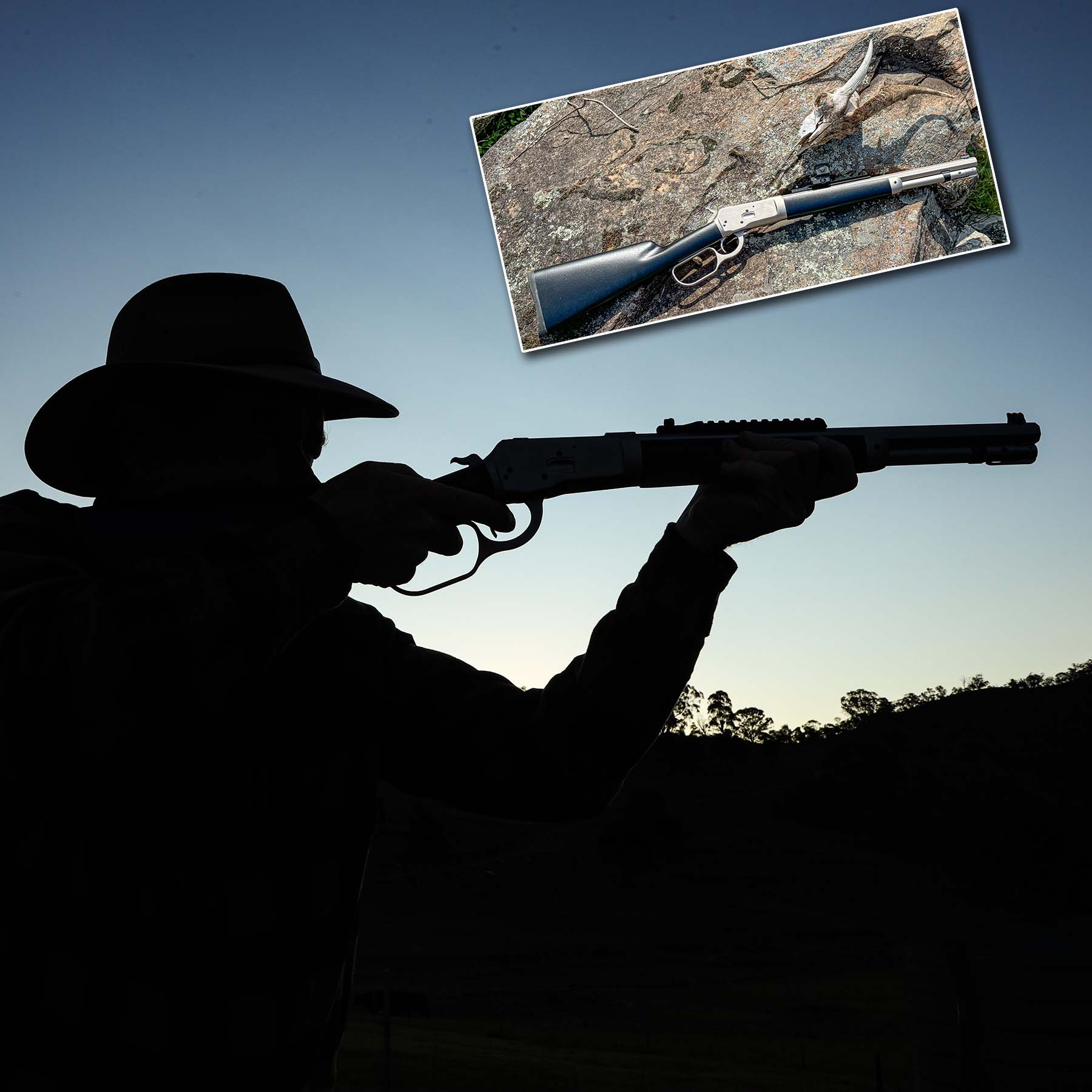


The stumpy, lever-action Chiappa 1892 Alaskan Takedown is a rare blend of vintage class and scrub-gun practicality with some extra touches thrown in. It’s one of those rifles that plants an ear-to-ear grin on your face.
It’s the epitome of a fun close-range rifle for hunting and for blasting targets, especially as it’s chambered in .357 Magnum, which gives you ammo options from full-power .357 hunting loads to low-recoil, cheap .38 Special plinking loads.
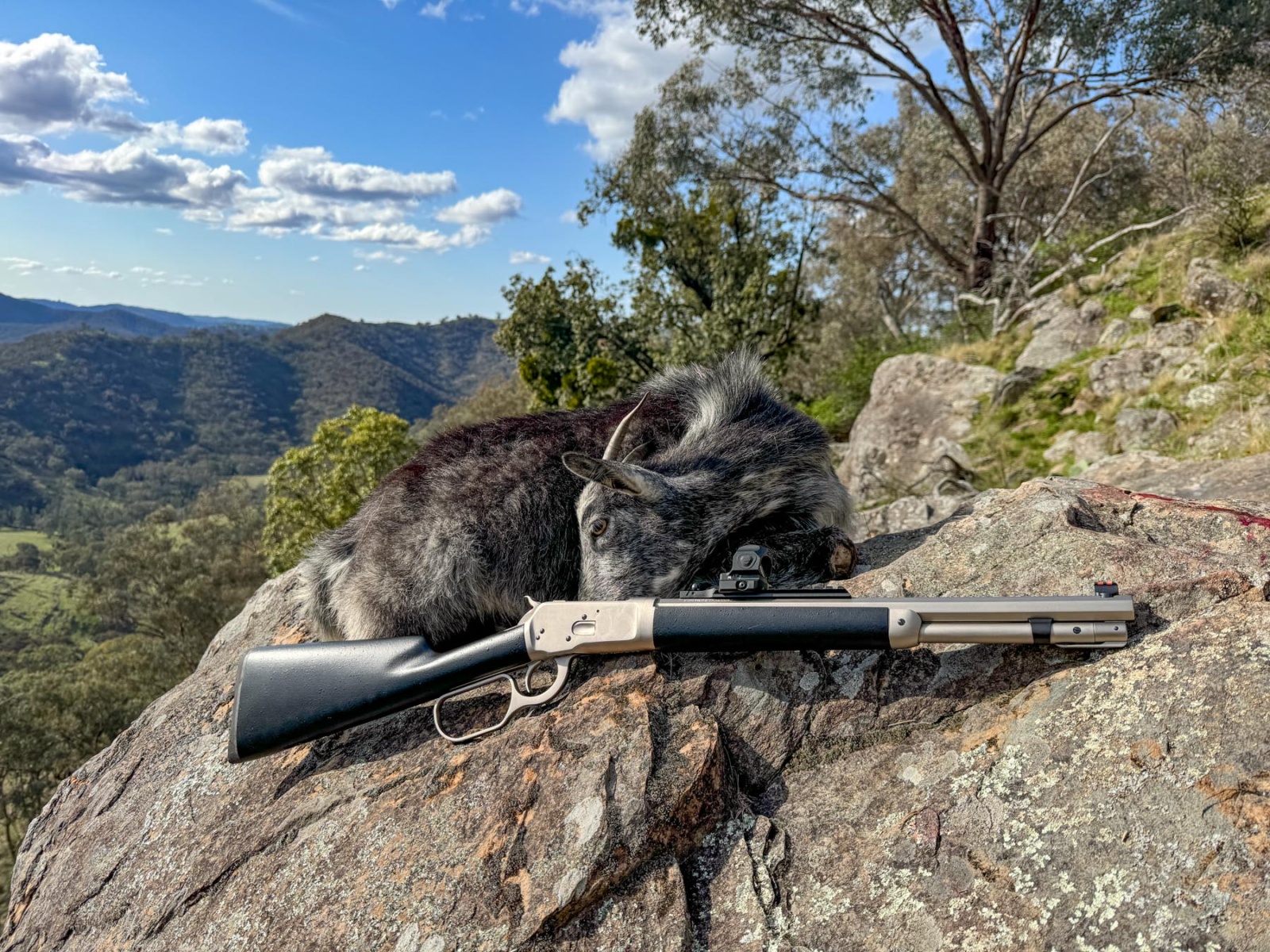
It’s the kind of tough, quick-handling firearm you can slip into a scabbard on a bike, quad or buggy and have ready for targets of opportunity.
The fact that it’s a fairly faithful replica of a design dating back to 1892 is something to celebrate. Rather than becoming obsolete about a century ago, what was originally the Winchester Model 1892 is still being made by a number of companies and Chiappa lists almost 70 versions of its own, not all available in Australia.
Chiappa’s very authentic reproductions range from ultra-traditional timber-and-blued rifles to modern pop-culture (or perhaps ‘tac-culture’ is the better term) creations like the completely matte black version of this Alaskan.
The action is John M Browning’s original 1892 design, a smooth and simple setup that is still strong enough to handle modern magnum cartridges, at least in pistol calibres like the .357 and the .44. Actually, it’s said to be strong enough to cope with bigger cartridges, too, but they won’t fit into its nicely compact form.
The system is based on two locking blocks that are pulled downwards as you open the operating lever, sliding out of the slots cut into the sides of the breech bolt. Once they’ve released the bolt, continued movement of the lever pulls the bolt back.
A long, top-mounted extractor claw pulls spent cases with it and the ejector flicks them vertically — they land on your head if you’re a bit too gentle. The ejector has a double role, pushing the next cartridge into the chamber.
The bolt rides over the hammer, cocking the action when you open it. When the lever is fully forward, it requires a bit of effort to initiate the closing movement but not enough to even notice when you’re using it with purpose, and overall the action feels quite smooth and moves easily through the minor notchiness in certain parts of the cycle. The 1892 was always regarded as one of the slickest old-world lever guns.
You must cycle it with purpose, though. If you short-stroke it, you’ll eject the spent case but the next round won’t be fed up into position to feed when you close the lever. This only happened to me at the bench shooting lazy groups, never in the field.
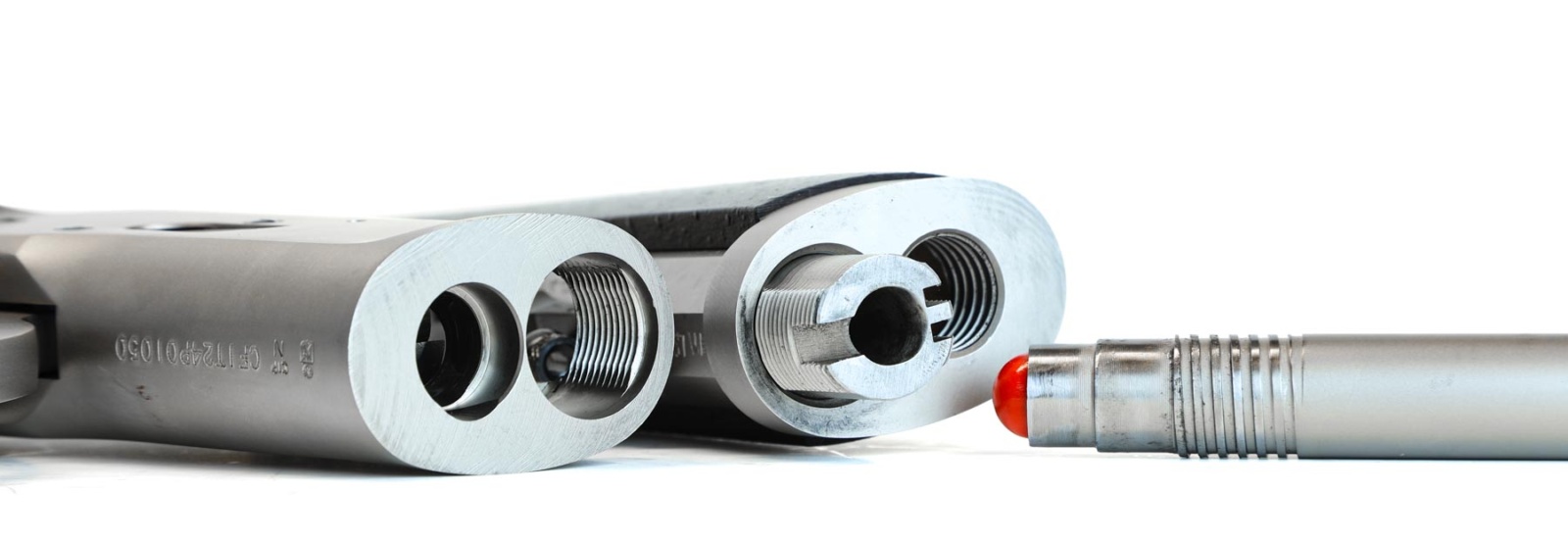
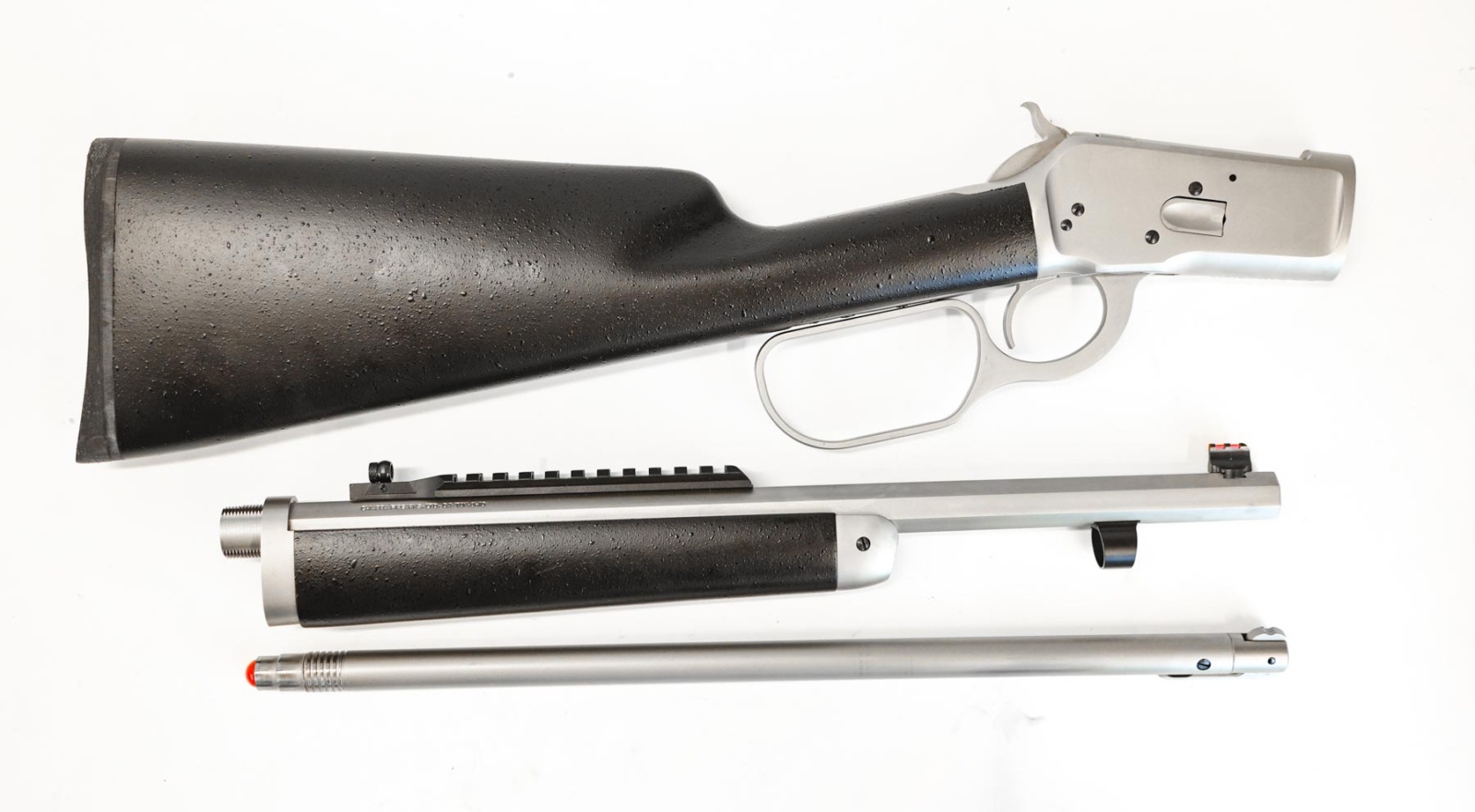
The takedown design of the Alaskan is sort of modern, dating from the latter half of last century rather than the one before. It’s simple and strong, based on an interrupted thread. You just open the main lever, open the small lever at the end of the magazine, unscrew the magazine tube, then give the barrel and fore-end a 90-degree twist and pull the two halves of the rifle apart. Reassembly is the opposite and takes moments.
Taking down the rifle enables you to pack it into a backpack, or maybe store it in a lockable drawer in your vehicle. When you reach your hunting grounds, put it together and off you go. There’s never a worry about retaining the rifle’s zero because the sights are all mounted on the barrel so cannot be misaligned.
The Chiappa’s trigger is a purler. Single stage, it lets off at a very consistent weight, averaging 1.45kg (3.2lb) in the test rifle, with no creep at all. It’s not what you’d call target-rifle crisp but it’s better than a lot of bolt-action rifles I’ve tested.
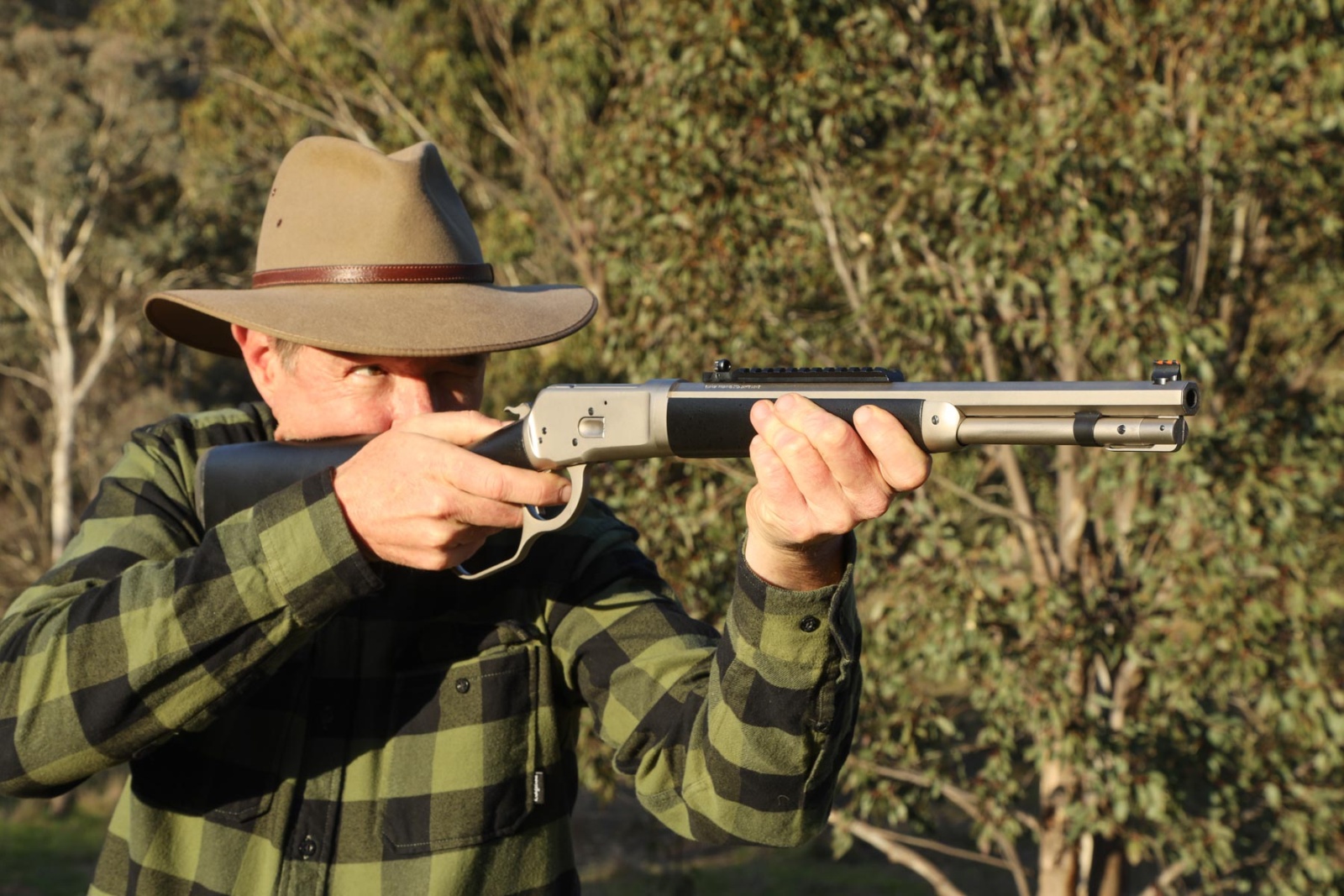
The only safety on the Chiappa is the half-cock position of the hammer, and there’s nothing to stop the hammer falling if the trigger is pulled before the lever is fully closed. However, in theory, even in the scenario where the action is as open as it can be to allow the hammer to fall, the locking bars are far enough into battery that the action won’t be flung open if a round goes off, and it’s unlikely the firing pin will strike the primer hard enough to make it go bang anyway. That’s the theory.
If the lever is only a poofteenth short of closing, the action is already locked closed. As long as you’ve got a good grip on the rifle with your firing hand, everything will be shut and locked solid.
The lever is not a big-loop type but not as small as others, either, making it good for Australian use because it’s not too open for bare hands but will accommodate you if you’re wearing the kind of gloves we might use in winter, as opposed to the bloody great mitts the Yanks might use in freezing Alaska.
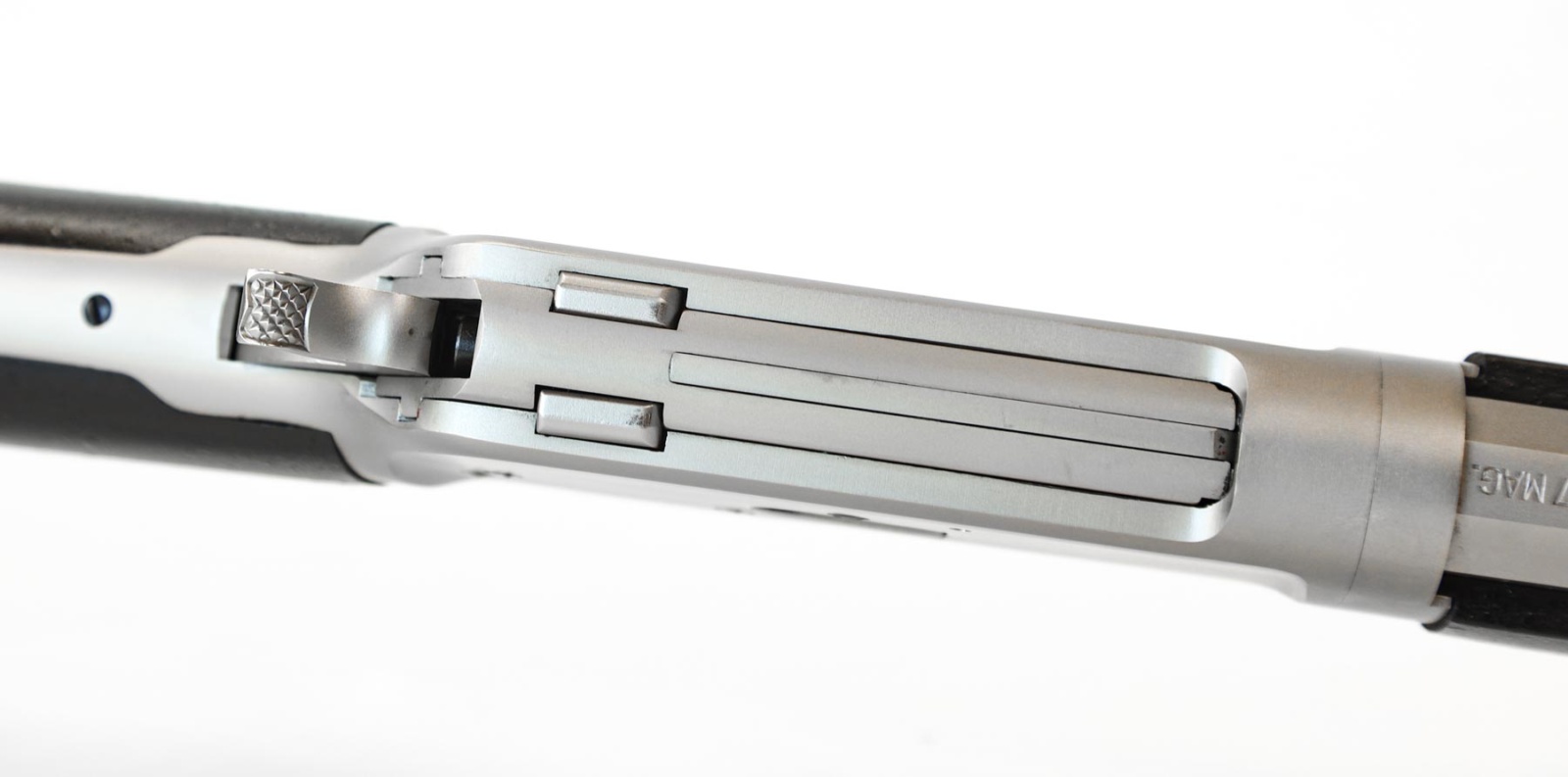
The hard chrome of the metalwork is a weather-beating variation, with a dull finish so it doesn’t shine too brightly in the bush. It looks fantastic, especially against the black finish of the stock, which is another modern innovation. The rubber coating over the underlying walnut stock has a pimply surface that’s very secure to hold onto.
The stock’s straight grip doesn’t spread the load evenly between your middle, ring and little fingers but that’s no bad thing considering how much a little finger can influence pulling you off aim if you tense up when you fire. I find it comfortable and its length is generous. Length of pull at just over 35cm is fine. The fore-end is slim and easy to hang onto, particularly with the minimal recoil in a .357. The butt’s thin rubber pad is firm but it’s not asked to do much.
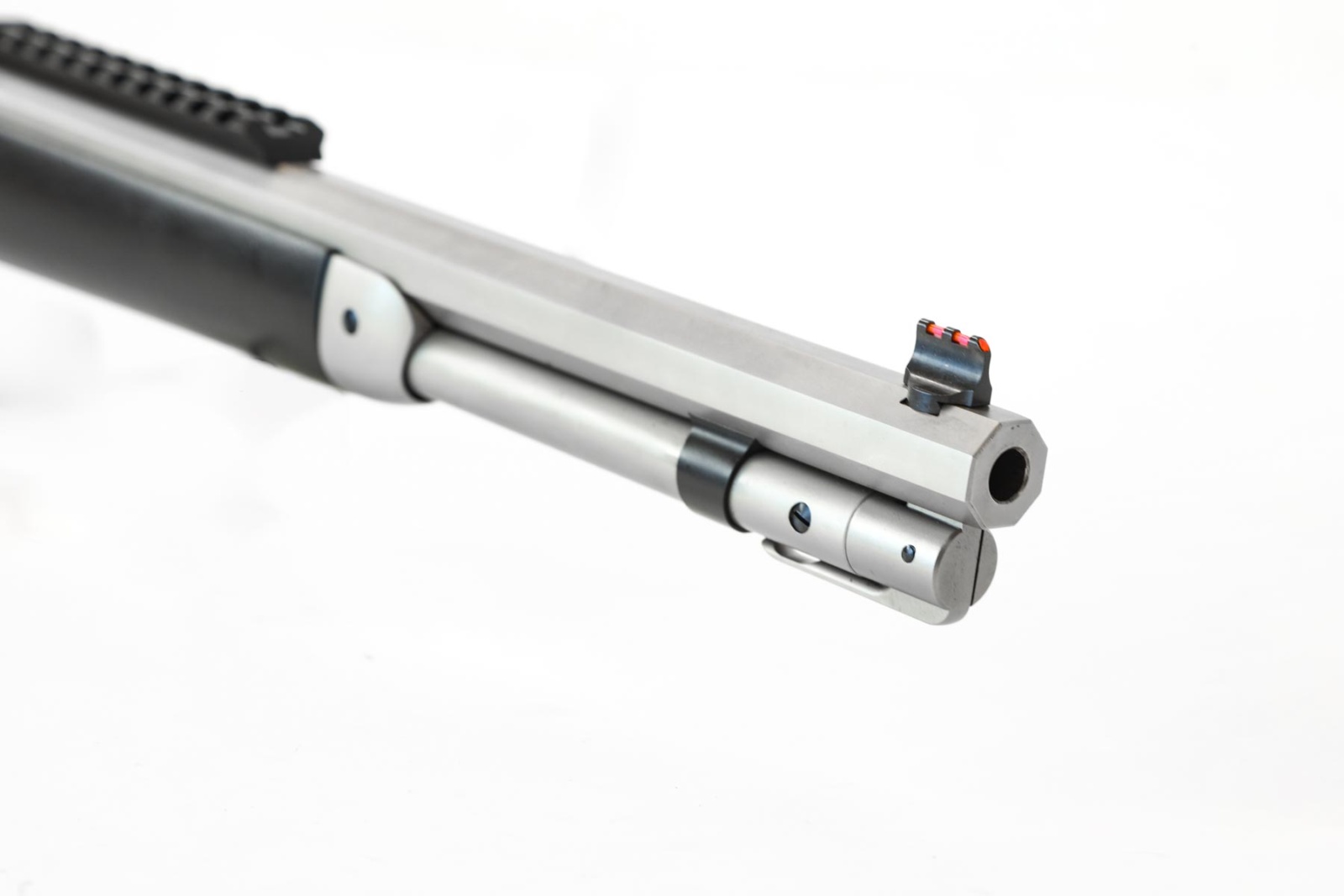
The barrel is only 40cm (16 inches) long, less than half of the Chiappa’s overall 87cm length. It’s hexagonal, more to be cool than for any ballistic benefit, but if it were round it’d be 20mm thick — definitely a heavy profile. Its weight restores balance to the 3.1kg rifle that might have been lost to a lighter barrel, and the point of balance is where the bolt meets the barrel — or exactly where your hand holds the rifle at the trail. Perfect, in other words, and it feels that way when you shoulder the little Chiappa.
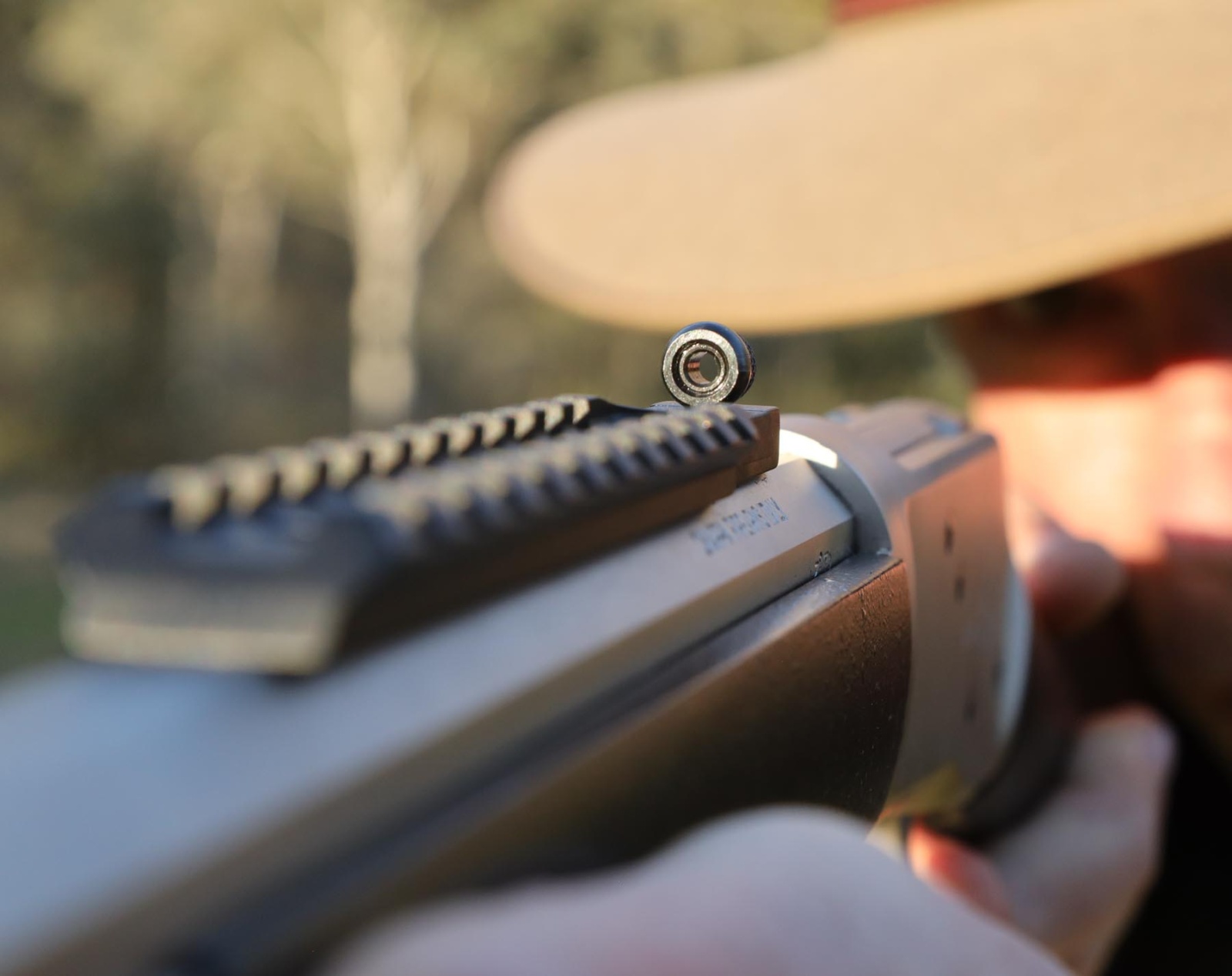
This, combined with the good trigger and the peep sight, results in an accurate rifle in a very practical sense. It’s quick and rather instinctive to shoot and if your technique is half decent you’ll hit what you’re aiming at, whether stationary or running. The Chiappa’s field accuracy is more impressive than its benchrest ability, which needs to be considered in the right context.
Unlike most 1892s, the Alaskan Takedown wears a Skinner peep sight on a Picatinny-type rail with a hi-vis red bead sight up front. The aperture has two sizes: a small opening or, if you unscrew the insert, a larger one. I’d argue the larger aperture is best for hunting because it provides a better view of the target and quicker target acquisition. Either way, aperture sights are vastly superior to the old buckhorn sights.
The rail, added to the Alaskan fairly recently, allows you to mount an optic — perhaps a scout scope with long eye relief or, as I did, a red dot sight in the form of ZeroTech’s new Trace 1×28 HALO. I also used a regular scope for accuracy testing, but not hunting.
Naturally, I sighted in the Alaskan before hunting with it. For this rifle, it was done at 50m rather than the usual 100, mainly because of the open sights and my rather ordinary eyes, which can’t focus the sights as well as I’d like. I used the Skinner sight only on its larger aperture.
The results were OK on the target. Using the red dot reduced the group sizes by about 20 percent; the riflescope brought a similar improvement again. The results, based on groups shot with the scope, are in the table below and if they don’t look impressive, remind yourself that every shot was the equivalent of a dead pig at 100 metres.
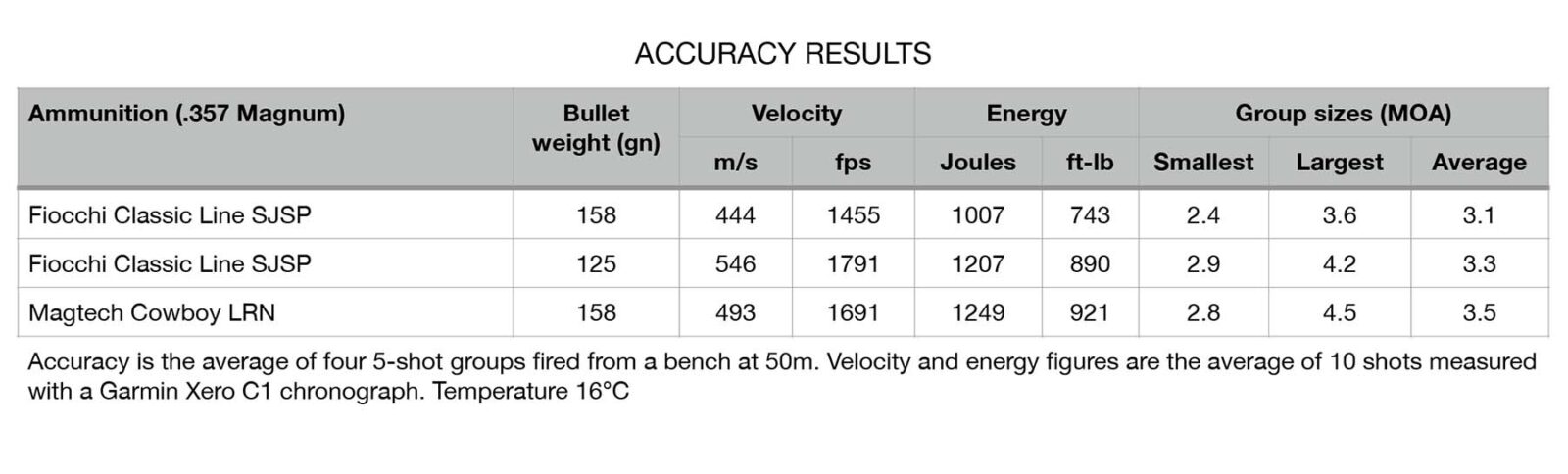
If you’re buying an Alaskan Takedown to shoot pigs at longer ranges, you’re hunting with the wrong dog. The .357 magnum is starting to run out of energy and trajectory much beyond about 150m.
I didn’t find pigs but I did stalk plenty of goats. The longest shot was 107m, offhand, and a kill. The speed of the Chiappa, and the dexterity with which you can wield it, put paid to several small mobs of goats and made inroads into larger mobs before the rest had bolted or it was time to reload. On the first day’s hunting, I fired 12 shots, often on running goats, for 11 hits (I fired a thirteenth as a finisher). This proved typical, and you can’t complain about that for practical accuracy.
The 125gn and 158gn Fiocchi semi-jacketed soft points I used were extremely effective, causing large wounds and massive blood loss. Zeroed at 75m, the 158 grain bullet is about 6cm high at 50 and 11cm low at 125; the 125-grainer is 4cm high at 50 and 8cm low at 125.
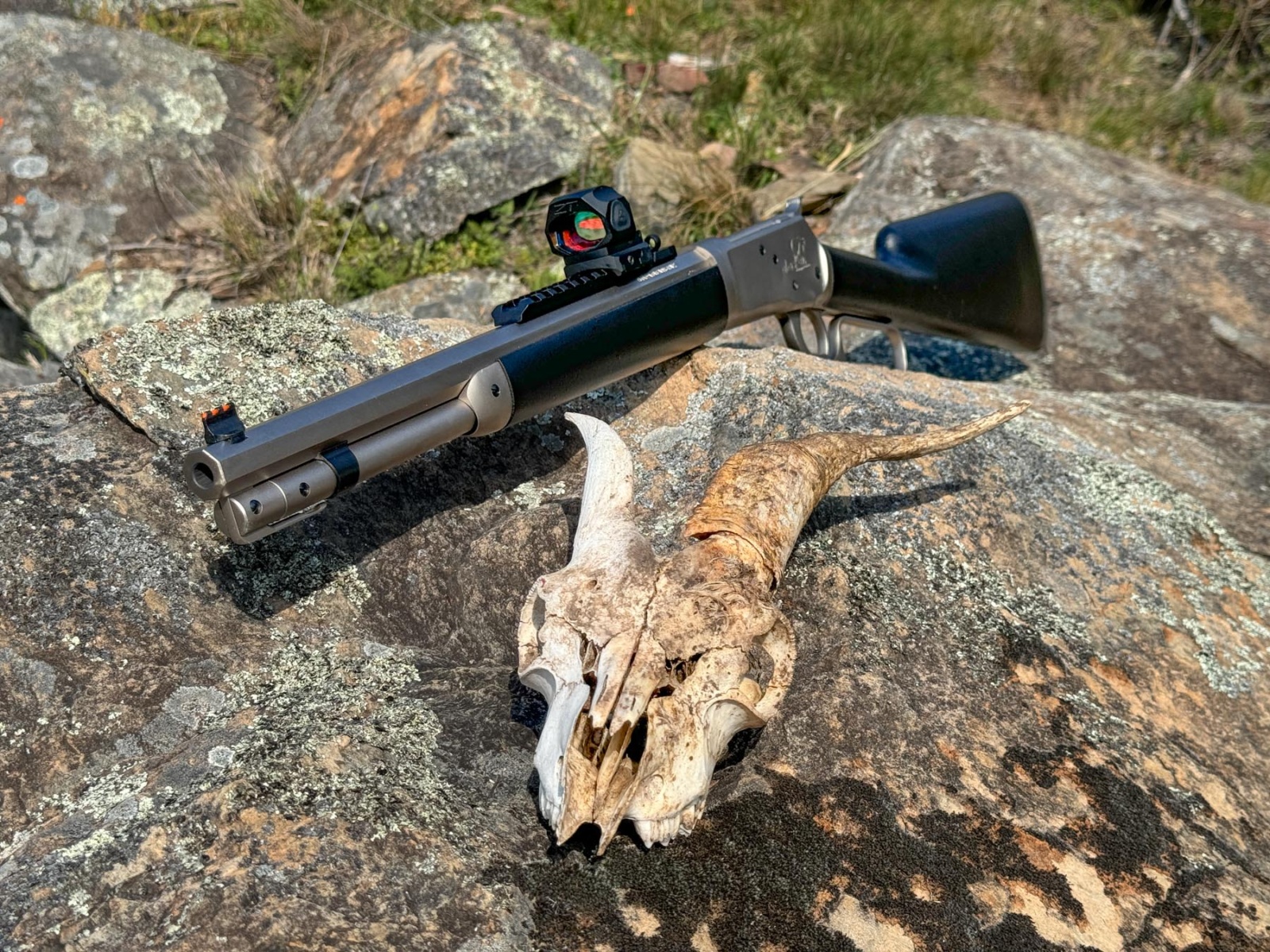
Refilling the eight-round tube magazine takes less than a minute. It’s not hard at all to feed cartridges into the loading gate, and topping up is simple too because when you press the gate open it forces the underlying shell forwards and out of the way.
A word of warning: don’t feed your Chiappa wadcutters or even semi-wadcutters because it needs a nice, rounded bullet to cycle properly. Hunting bullets feed fine, as do lead round-nose and flat-nose rounds, but the others will give you grief. If you use .38 Special, make sure they’re at least 39mm in overall length. Also, keep the 1892’s action well lubricated.
Chiappa makes a good quality, faithful reproduction of the original Winchester Model 1892 rifle that functions perfectly and has the character you’d be hoping to find. The Alaskan Takedown’s modern materials and finishes are a departure from the theme but they are practical in all weather and will take a beating. Besides, it’s a very cool, cute rifle — and a lot of fun.
Many thanks to Mudgee Firearms for the always friendly service and helping with the transfers and logistics of this test.
SPECIFICATIONS
- Manufacturer: Chiappa, Italy
- Type: Lever action takedown
- Calibre: .357 Magnum (.44 Magnum available, plus .45 LC in 50cm barrel)
- Barrel: 40cm (16”), 1:19 twist, heavy hexagonal profile (50cm/20” option available)
- Magazine: Tubular, 8 rounds
- Stock: Walnut with black rubber coating
- Trigger: Single stage, 1.4kg
- Safety: Half-cock hammer
- Sights: Skinner peep sights with pic rail
- Length: 87cm (34”)
- Weight: 3.1kg
- RRP: $2599
- Distributor: TSA Outdoors


0 Comments