


While governments search for new answers to Australia’s wild pig problem, one of the best solutions has been there all along.
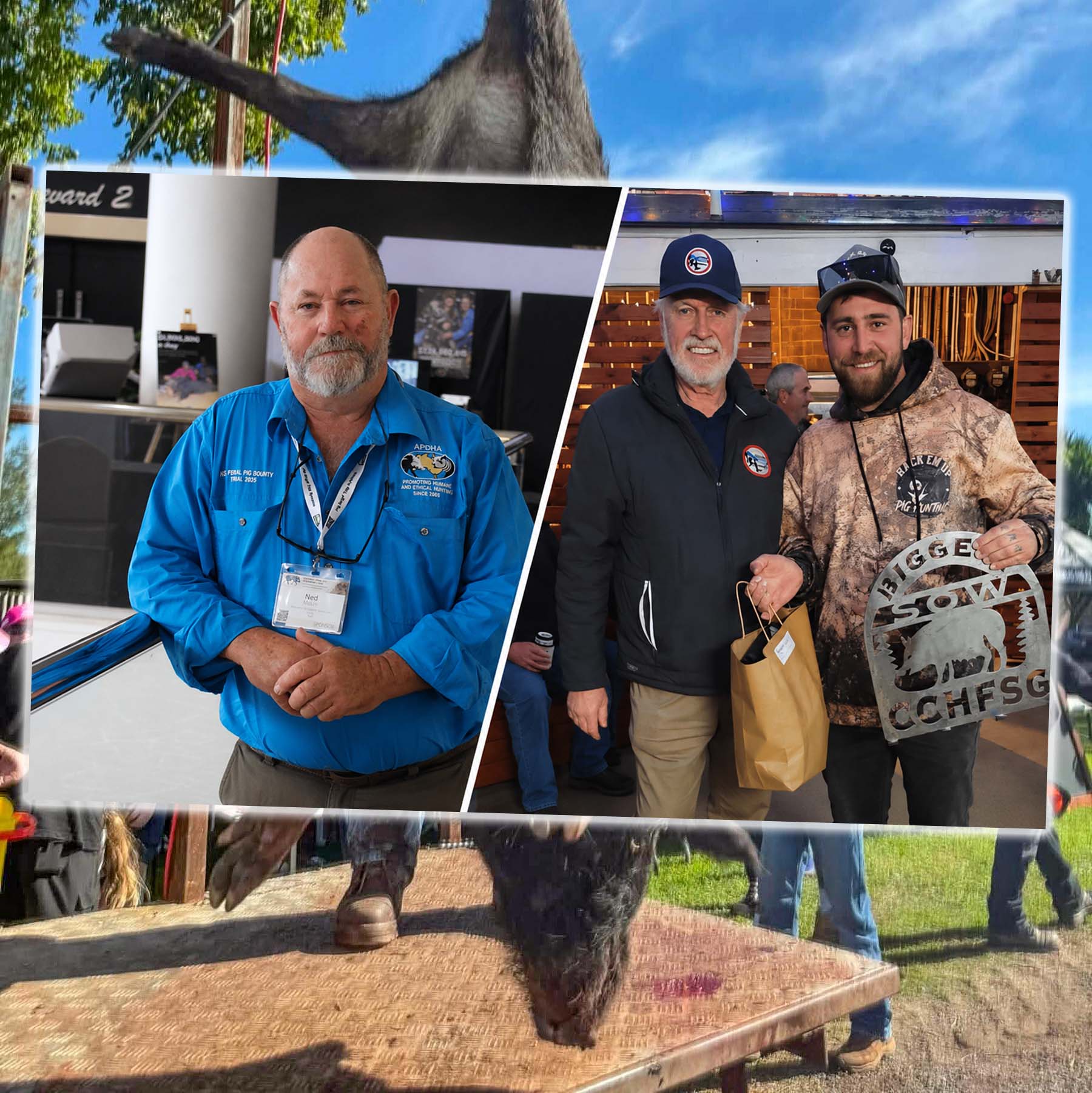
Nearly 3000 wild pigs. That was the headline from this year’s Curlewis Pig Hunting Competition, where volunteer hunters removed 2912 pigs in a single weekend. A pig every 66 seconds.
But the number that stayed with me was zero. That is how much taxpayers paid the hunters who did the work.
Every time wild pigs make the news, the response follows the same tired script. We see farmers call for help. Then politicians promise another package. Bureaucrats reach for more aerial shooting, poison, strategies and reviews. Environmental groups demand government action.
Wild pigs are a serious problem. Nobody disputes that. But after spending a couple of hours talking with Australian Pig Doggers and Hunters Association (APDHA) president Ned Makim, I kept coming back to a more obvious question: what are thousands of volunteer hunters already doing, and why are they still treated as an afterthought?
MORE THAN A PIG HUNT
If you have never been to one of these competitions, it is easy to reduce them to dogs, utes, dead pigs and prize money. That is usually where the public conversation ends.
The reality is much bigger. Long before the first dog is unloaded, volunteers are finding sponsors, organising prizes and catering, setting rules and working with landholders. When the weekend arrives, accommodation fills, local businesses benefit and people who might live hours apart get a chance to catch up.
Ned’s point was simple: outsiders see the final tally, while locals see the organisers, families, landholders, fundraising, friendships and community effort around it.
If all you see is the photograph taken after the weigh-in, you have missed most of the story.
BUILT BY VOLUNTEERS
Nobody is paying these hunters to be there. They buy their own fuel, train and feed their dogs, pay the vet bills, maintain their vehicles and give up their weekends.
Australia normally celebrates that sort of effort. We praise the SES, Rural Fire Service, surf lifesavers, Landcare groups, junior sport and Clean Up Australia Day.
Yet the mood changes when the volunteers wear camouflage and carry rifles.
That double standard is hard to justify. These hunters are spending their own time and money helping landholders deal with one of Australia’s worst invasive species. They are not asking for a wage or sending government an invoice. They are already doing the work.
The environmental lobby talks endlessly about “community engagement” — until the community turns up wearing camouflage.
Curlewis also showed that these events create more than pig numbers. Ned met visitors who had returned because they enjoyed the competition and wanted to know where the next one was.
The Curlewis Pig Competition has groupies.
Governments spend millions trying to manufacture regional tourism, while volunteer-run pig competitions are already filling rooms, bringing people into local towns and creating interest in a possible circuit of events. Nobody in Macquarie Street designed that. The community built it.
THE GREAT AUSTRALIAN PIG HUNT
Curlewis showed what volunteers could achieve in one weekend. The Great Australian Pig Hunt asked a bigger question: what are pig hunters contributing across the country?
APDHA launched the initiative in 2024 to replace assumptions with data. Its inaugural survey estimated hunters removed more than 5.3 million wild pigs nationwide, including almost 1.7 million in New South Wales.
It also estimated pig hunters injected more than $326 million into regional economies through fuel, accommodation, dog food, veterinary bills, vehicles and equipment. On average, they spent about $60.67 for every pig removed.
That was their money, not the taxpayers’.
For years, the contribution of volunteer hunters was discussed through anecdotes. The Great Australian Pig Hunt began measuring it: millions of pigs removed, hundreds of millions spent in regional communities and thousands of people funding the work themselves.
We are constantly told public policy must be evidence based. Here is evidence that deserves to be taken seriously.
THE SCIENCE NOBODY IS TALKING ABOUT
The numbers are impressive, but the science may prove even more valuable.
APDHA volunteers began collecting pig ear samples for genetic research. Working with university researchers including Professor Di Gleeson in Canberra and Professor Ben Allen in Southern Queensland, the association has assembled what Ned says researchers told them could become the largest wildlife DNA collection of its kind in the world.
The samples could help study pig genetics, population movement and disease pathways. Yet when APDHA needed an ultra-low-temperature freezer to preserve them, the hunting community raised the money itself.
A volunteer hunting organisation is building a potentially world-leading scientific collection and buying laboratory equipment with raffle money.
That should make decision-makers uncomfortable.
The volunteers were available. The researchers were interested. The samples were being collected. Hunters were still left to pass the hat around and get on with it themselves.
Imagine how much further the project could go if volunteer hunters were treated as conservation partners rather than people consulted after the important decisions have already been made.
So why are we still getting this wrong?
Ned is not arguing that hunters should replace every other form of pig control. Aerial shooting, trapping, poison and professional pest controllers all have a role. Volunteer hunters have one too.
The sensible approach is to use every effective tool and coordinate them properly.
That was one of the ideas behind the Shooters Fishers and Farmers Party’s bill, the Conservation Hunting Bill 2025, which remains before the NSW Parliament. It proposed a statutory Conservation Hunting Authority to promote conservation hunting and improve coordination between hunters, landholders, researchers and government agencies.
The Greens and several environmental organisations fiercely opposed it. They cannot keep demanding action on wild pigs while smearing and dismissing the volunteers already removing millions of them. Ideology has no place when you claim to trust science and data.
If hunters are removing millions of pigs, spending hundreds of millions of their own dollars in regional Australia and helping build a major scientific resource, what exactly is achieved by keeping them at arm’s length?
Curlewis volunteers did not wait for another strategy, review or grant. They saw a problem and got to work. Across Australia, thousands of hunters are doing the same thing every weekend.
The next time somebody says the answer is simply more government, ask what government is doing to support the conservation army we already have.


0 Comments